School Climate & Safety

Court Rejects ED Stance in Spec. Ed. Discipline Case

By Lynn Schnaiberg — February 12, 1997 4 min read
  • Save to favorites
  • Print

The U.S. Department of Education cannot withhold special education dollars from Virginia because the state does not require that disabled students who are suspended or expelled from school receive educational services, a federal appeals court ruled last week.

In an 11-2 vote, the U.S. Court of Appeals for the 4th Circuit in Richmond, Va., reversed a three-judge panel’s earlier decision that found in favor of the Education Department. That 2-1 decision was handed down last June.

In light of the most recent ruling in this closely watched case, the federal education agency now is considering an appeal to the U.S. Supreme Court. The issue of disciplining special education students has gained a higher profile in recent years as states have enacted laws designed to deter violence in schools.

“While we are deeply concerned with discipline and safety in schools, we strongly support every child’s right to an education,” a spokesman for U.S. Secretary of Education Richard W. Riley said last week. “We are disappointed in the ruling and will be considering an appeal.”

But the Feb. 5 ruling drew praise from school groups. Many have long argued that the Education Department has overstepped its bounds in interpreting the chief federal special education law--the Individuals With Disabilities Education Act--and in enforcing the law based on such interpretations.

The IDEA guarantees that disabled students have the right to a “free, appropriate public education.” Federal officials have argued that the law provides no exception to that mandate--even if the behavior that triggers a suspension or expulsion is unrelated to a student’s disability, as in the Virginia case. The IDEA does not explicitly address discipline.

‘Attempted Coercion’

In Virginia, students who are suspended or expelled--disabled or not--are not entitled to receive alternative education services. Virginia officials and other critics have argued that the federal government’s position fosters a double standard in which disabled students do not have to face consequences for their actions.

“This is a landmark decision by the Fourth Circuit that should bring cheer to parents and school leaders all across the country,” Republican Gov. George F. Allen of Virginia said last week. “Hopefully the federal Department of Education will accept this decision and cease their attempted coercion.”

The dispute dates to 1994, when the Education Department threatened to withhold nearly $60 million in federal special education money because Virginia refused to change its discipline policy. When Virginia officials went to the appeals court in March 1994, the court said the the case first had to go through an administrative appeal. Virginia lost at the administrative level in 1995, and the three-judge panel of the 4th Circuit court ruled against the state in 1996. State officials then asked the full appellate court to review the case, which resulted in their victory last week. (“Disciplining Special-Education Students: A Conundrum,” Nov. 30, 1994 and “Va. Is Ordered To Serve Expelled Spec.-Ed. Students,” April 19, 1995.)

“The secretary of education and the assistant attorney general acknowledge, as they must, that IDEA at most only implicitly conditions the states’ receipt of funds upon the continued provision of educational services to students expelled for misconduct unrelated to their handicaps,” Judge J. Michael Luttig said in a portion of the opinion joined by a majority of the court. “In order for the states to be bound by a condition upon the receipt of federal monies, the Congress must have affirmatively imposed that condition in clear and unmistakable statutory terms.”

Back to Court?

Meanwhile, the National School Boards Association and other groups hailed the ruling.

“This is a big victory for Virginia and a lot of other states and school districts,” said Gwendolyn H. Gregory, the deputy general counsel for the school boards’ group. “The U.S. Education Department would have a heck of a time imposing this rule after being hit with this ruling.”

Both the NSBA and the American Association of School Administrators have argued that schools need more flexibility in disciplining disabled students. The administrators’ group does not support cutting off services to any student, said Bruce Hunter, the group’s senior associate executive director.

When the Virginia case began, state officials agreed to provide services to the students in question while the case made its way through the courts. Since 1994, the state has spent $1.5 million to serve roughly 900 suspended or expelled special education students, said Margaret N. Roberts, a spokeswoman for the Virginia education department.

Legal experts said last week’s ruling is notable because the courts often defer to a federal agency’s interpretation of a law.

Assuming that the federal government decides to appeal the case, whether the Supreme Court would agree to hear it is unclear. The court rejects far more cases than it accepts for review. But if the case is accepted, Virginia might have an uphill battle, said Perry A. Zirkel, a professor of education and law at Lehigh University in Bethlehem, Pa.

“Historically the court has given a pretty expansive interpretation of children’s rights under the IDEA,” Mr. Zirkel said.

Regardless, the case is sure to surface when Congress begins to retool the IDEA later this year. (“Discipline Again To Top Special Ed. Debate,” Jan. 29, 1997.)

Related Tags:

Events

Early Childhood Webinar Selling Into Early Learning: New Survey Data and Strategies for Marketers
Selling into PreK? Get fresh EdWeek Research Center data and strategies to position your products and reach the right early learning buyers.
Artificial Intelligence Webinar AI and 'Techlash' Are on a Collision Course. How Should Schools Respond?
Learn what strategies and tactics schools can develop to encourage smart and responsible AI use, while also enforcing tech guardrails.
This content is provided by our sponsor. It is not written by and does not necessarily reflect the views of Education Week's editorial staff.
Sponsor
Special Education Webinar
Special Education Disputes & Rising Costs: Protecting Your District
Special education costs and risks are rising. Learn how stronger IEP and Medicaid processes help districts protect funding and compliance.
Content provided by Relay

EdWeek Top School Jobs

Teacher Jobs
Search over ten thousand teaching jobs nationwide — elementary, middle, high school and more.
View Jobs
Principal Jobs
Find hundreds of jobs for principals, assistant principals, and other school leadership roles.
View Jobs
Administrator Jobs
Over a thousand district-level jobs: superintendents, directors, more.
View Jobs
Support Staff Jobs
Search thousands of jobs, from paraprofessionals to counselors and more.
View Jobs

Read Next

School Climate & Safety A Shooting Strikes an Elementary School. Some Doubt Policy Change Will Follow
Tragedies like the one in Bend, Ore., draw public outcry, but typically not swift change on school safety.
5 min read
Children place flowers at a makeshift memorial outside Silver Rail Elementary in Bend, Ore., Friday, Oct. 16, 2026, a day after a deadly shooting.
Children place flowers at a makeshift memorial outside Silver Rail Elementary in Bend, Ore., Friday, Oct. 16, 2026, a day after a deadly shooting. The child victims, ages 5, 8, and 11, include the youngest person killed in a school shooting since Education Week began<a href="https://www-edweek-org.ezproxy.baylor.edu/leadership/school-shootings-this-year-how-many-and-where/2026/01" target="_blank" link-data="{&quot;cms.site.owner&quot;:{&quot;_ref&quot;:&quot;00000173-0561-d1f0-a17f-adef4bee0000&quot;,&quot;_type&quot;:&quot;ae3387cc-b875-31b7-b82d-63fd8d758c20&quot;},&quot;cms.content.publishDate&quot;:1792177418426,&quot;cms.content.publishUser&quot;:{&quot;_ref&quot;:&quot;00000180-d7b2-d193-a1b2-dfbba3aa0001&quot;,&quot;_type&quot;:&quot;6aa69ae1-35be-30dc-87e9-410da9e1cdcc&quot;},&quot;cms.content.updateDate&quot;:1792177418426,&quot;cms.content.updateUser&quot;:{&quot;_ref&quot;:&quot;00000180-d7b2-d193-a1b2-dfbba3aa0001&quot;,&quot;_type&quot;:&quot;6aa69ae1-35be-30dc-87e9-410da9e1cdcc&quot;},&quot;link&quot;:{&quot;disableUtmTracking&quot;:false,&quot;target&quot;:&quot;NEW&quot;,&quot;attributes&quot;:[],&quot;url&quot;:&quot;https://www-edweek-org.ezproxy.baylor.edu/leadership/school-shootings-this-year-how-many-and-where/2026/01&quot;,&quot;_id&quot;:&quot;000001a1-4619-d1d1-a3f3-f77b151b0000&quot;,&quot;_type&quot;:&quot;ff658216-e70f-39d0-b660-bdfe57a5599a&quot;},&quot;linkText&quot;:&quot; tracking these incidents&quot;,&quot;theme.brightspot-theme-default.:core:enhancement:Enhancement.hbs.enhancementAlignment&quot;:null,&quot;theme.brightspot-theme-default.:core:link:Link.hbs._template&quot;:null,&quot;theme.brightspot-theme-default.:core:link:Link.hbs.type&quot;:null,&quot;theme.brightspot-theme-default.:core:link:Link.hbs._preset&quot;:null,&quot;theme.brightspot-theme-default.:core:enhancement:Enhancement.hbs._preset&quot;:null,&quot;_id&quot;:&quot;000001a1-4619-d1d1-a3f3-f77b14b10001&quot;,&quot;_type&quot;:&quot;809caec9-30e2-3666-8b71-b32ddbffc288&quot;}"> </a>tracking those incidents eight years ago.
Joe Kline/AP
School Climate & Safety Three Children and Teacher Killed in Oregon Elementary School Shooting
Authorities in Bend, Ore., said the attacker gained entry by shooting through locked doors.
2 min read
Police tape is placed outside Silver Rail Elementary school following a shooting, on Oct. 15, 2026 in Bend, Ore.
Police tape is placed outside Silver Rail Elementary School following a shooting, on Oct. 15, 2026 in Bend, Ore. Authorities said an attacker shot through locked school doors to enter the building.
Joe Kline/AP
School Climate & Safety 4 Ways AI Data Centers Can Affect Schools
From health to productivity and finances, data centers could pose risks for students and schools.
3 min read
Carroll
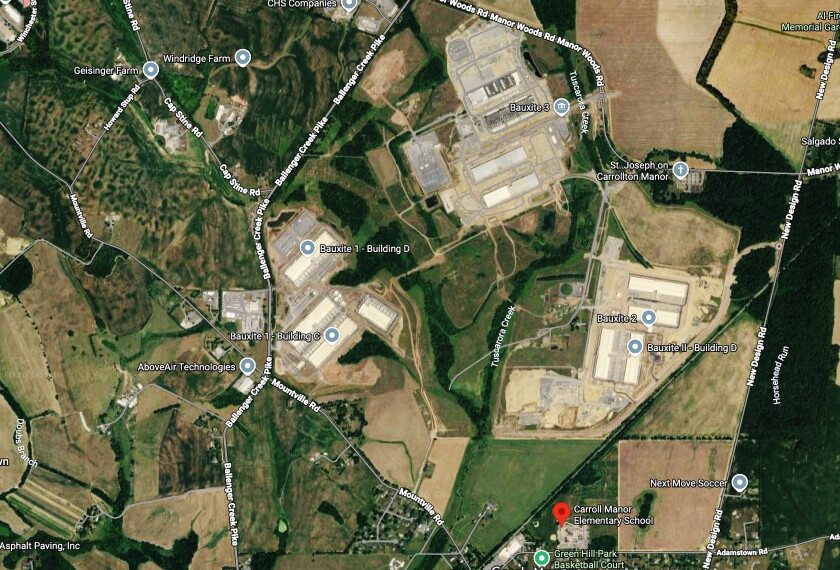
The Quantum Frederick Data Center Campus near the Carroll Manor Elementary School.
Map data ©2026 Google, Imagery ©2026
School Climate & Safety For Students Walking to School, the Route Can Be Deadly. What Can Make It Safer?
School districts, including New York City, have rolled out a number of strategies to reduce risks.
5 min read
A student leaving Greenspun Junior High School in Henderson, Nev., enters a car in the travel lane of Valle Verde Drive on Sept. 14, 2022. Pedestrian fatalities near schools are most likely to occur in the early morning and early evening hours, federal data show.
Rachel Aston/Las Vegas Review-Journal via TNS