Student Well-Being & Movement Q&A

A Superintendent Explains Why Her District Is Suing Social Media Companies

By Arianna Prothero — February 28, 2024 3 min read
Teenage girl looking at smart phone
  • Save to favorites
  • Print

Student mental health and behavioral issues have become a major drain on district resources in California’s San Mateo county in recent years—a troubling trend that administrators in the district believe is rooted in students’ overuse of social media.

After trying other fixes, such as hiring more mental health support staff in schools, the county school district decided to take a drastic step to get the attention of lawmakers and major social media companies, said Nancy Magee, the county’s superintendent of schools, a role that oversees 23 local school districts south of San Francisco.

The district sued the companies that own Snapchat, TikTok, and YouTube last year, alleging that they design highly addictive products that are harming its students’ mental health. San Mateo is among more than 200 school districts across the country to do so. Meta, which owns Instagram and Facebook, is also a defendant in many of those lawsuits.

For their part, the social media companies counter that they continue to take robust measures to protect young people on their platforms and discourage overuse.

Magee spoke with Education Week to discuss the unique challenges social media creates for schools and her concerns that technology is outpacing the regulation needed to keep young people safe.

This conversation has been edited for length and clarity.

Nancy Magee

You said social media has been a drain on your schools. How so?

We’re understaffed in schools in America. We don’t have enough adults on campus to really support the needs of students. And these complex needs are so much more different than when I entered the classroom to teach 35 years ago. It’s a completely different landscape because [students are] just sadder. They’re just more anxious.

They’re involved in this whole other digital universe that didn’t exist 35 years ago. And it’s invisible. The teacher can’t really see it. Being a teenager is a time of upheaval and major growth. Some people may say drama, but it’s exacerbated to the nth degree by the power of the social media platforms, because where you might pass a note in the old days to a friend and say something mean, now all of a sudden, if you do that online, the entire school or school district sees it.

See also

A close up of a statue of the blindfolded lady justice against a light blue background with a ghosted image of a hands holding a cellphone with Facebook "Like" and "Love" icons hovering above it.
iStock/Getty

I’m talking about the complexity that the digital world presents to us. I welcome and embrace technology for learning. But the tools are accessible before society is able to manage it. Everybody’s talking about AI and all the unintended consequences and impacts of that. We don’t even have an idea of what that is, so we don’t know how to make laws or how to create social behavior norms around that. The same is true for social media platforms.

The mental health crisis for young people is real. Social media plays a significant role in that. It’s not the sole driver of it, but certainly is a huge impact.

If social media is not the sole driver of the mental health crisis, what else is driving it?

I think there is a thread that runs under all of it.

We’re overwhelmed with instantaneous information. Kids can basically learn about anything they want to, which you would think is a good thing. But, [for example], a lot of kids are very, very upset about the climate of the planet.
See also

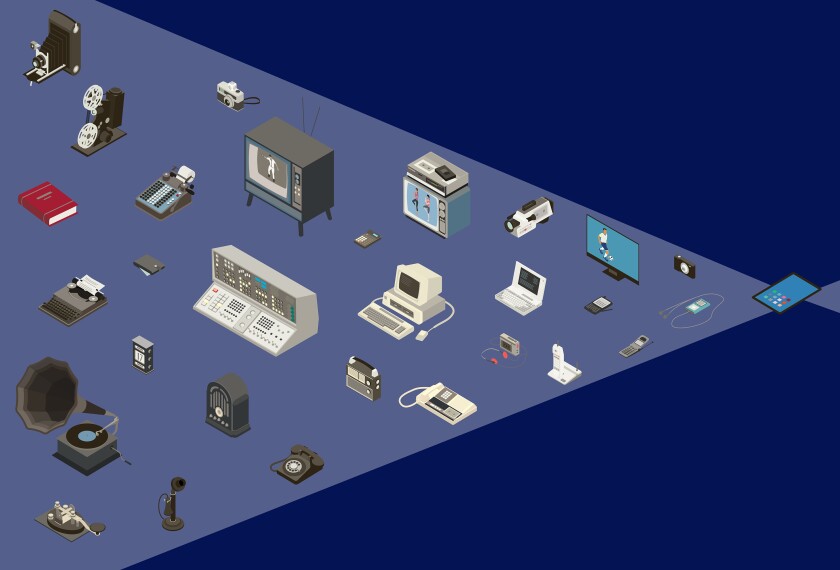
Vector illustration of 30 items and devices converging into a single smart device. Your contemporary tablet is filled with a rich history, containing ways to record and view video, listen to music, calculate numbers, communicate with others, pay for things, and on and on.
DigitalVision Vectors

Something that they’re worried about suddenly is in their face constantly. Whereas when we were kids, we could be worried about something, but we had to wait until the evening news. Or the newspaper would come in the morning and we overhear mom and dad talking about it. We’d be a little bit nervous, but then it would kind of just go away. But today, it’s just constantly there.

It’s ever present. It’s overwhelming. It’s also immediately accessible.

We have to live with social media. But what you’re saying with your lawsuit is: ‘We can’t do it alone. We need help.’ Right?

The lawsuit is really attacking the algorithms that are being utilized on these platforms purposely to keep kids online longer, as long as possible, and to send them down the next rabbit hole, which taps directly into the addiction chemicals in their brains, and then they find that they can’t stop.

Oftentimes, the answer to challenges in the world is education. And we do need to be investing more in the education of kids in their media literacy and their critical thinking skills and in monitoring their own mental health. But I think that the social media companies should have some accountability in that.

Events

This content is provided by our sponsor. It is not written by and does not necessarily reflect the views of Education Week's editorial staff.
Sponsor
Recruitment & Retention Webinar
Hiring, Retention, and Fill Rates: A Data-Driven Sub Strategy
Explore what keeps substitutes coming back and hear how one district rebuilt its substitute hiring process and improved its fill rate.
Content provided by Frontline Education
Early Childhood K-12 Essentials Forum Early Childhood Education: Building Essential Skills for Success
Join this free virtual event to examine the biggest challenges in supporting young children, from preschool through elementary school. 
This content is provided by our sponsor. It is not written by and does not necessarily reflect the views of Education Week's editorial staff.
Sponsor
Student Absenteeism Webinar
Attendance Isn't an Attendance Problem
Boost attendance by strengthening relationships, belonging, and support with practical strategies from Doug Fisher & Nancy Frey.
Content provided by Corwin

EdWeek Top School Jobs

Teacher Jobs
Search over ten thousand teaching jobs nationwide — elementary, middle, high school and more.
View Jobs
Principal Jobs
Find hundreds of jobs for principals, assistant principals, and other school leadership roles.
View Jobs
Administrator Jobs
Over a thousand district-level jobs: superintendents, directors, more.
View Jobs
Support Staff Jobs
Search thousands of jobs, from paraprofessionals to counselors and more.
View Jobs

Read Next

Student Well-Being & Movement Meta Reaches $17B Settlement With States Over Teen Social Media Addiction
The deal with 47 states requires Meta to add child-safety measures to Facebook and Instagram.
4 min read
Head of Instagram, Adam Mosseri, leaves the Ronald V. Dellums Federal Building & United States Courthouse as Meta is on trial over social media addiction in Oakland, California, on August 25, 2026. A coalition of US states is seeking around $200 billion in damages against Meta, which they accuse of intentionally designing Facebook and Instagram to be addictive for children, in a landmark trial.
Adam Mosseri, the head of Instagram, leaves the Ronald V. Dellums Federal Building and United States Courthouse in Oakland, Calif., on Aug. 25, 2026. Meta, Instagram's parent company, has agreed to a $17 billion settlement with 47 states to end a trial over teens' social media addiction.
Karl Mondon / AFP via Getty Images
Student Well-Being & Movement Nebraska's Largest School District Asks Police to Not Use Electric Shock Gloves on Students
Omaha's superintendent made the request after a report that federal immigration officials planned to to use the tools.
5 min read
A look at a Compliant Technologies Generated Low Output Voltage Emitter, G.L.O.V.E., at Omaha Police Headquarters in Omaha, Neb. on Friday, Aug. 14, 2026. The Generated Low Output Voltage Emitter, G.L.O.V.E., "is a less-lethal tool intended to provide officers with an additional option when responding to resistance or a potentially volatile situation," according to the Omaha Police Department.
A photo taken at Omaha, Neb., police headquarters on Aug. 14, 2026, shows a technology known as Generated Low Output Voltage Emitter, or G.L.O.V.E. Photo by Nikos Frazier/Omaha World-Herald via Getty Images. Police in the city agreed this week to stop carrying the gloves, which can deliver electric shocks, while working in schools in Nebraska’s largest public school district.
Nikos Frazier/Omaha World-Herald via Getty Images
Student Well-Being & Movement Opinion Why ‘Just Ask for Help’ Isn't Enough for Teens—and What Schools Can Do Instead
Mental health messaging is out of step with what students actually need, explains one high schooler.
Aanya Remi
4 min read
082024 Opinion REMI hesitant to seek help ly
Liz Yap/Education Week and Canva
Student Well-Being & Movement How a School Bus Will Serve as a Sensory Reprieve for Little Learners
A rural Head Start program will deploy the bus to give young kids tools to manage their emotions.
4 min read
HB A4346
An activity table inside the Pocono Services for Families and Children's new sensory bus on Aug. 20, 2026, in East Stroudsburg, Pa. The bus is set to hit the road this spring to help teach young students how to regulate their emotions through play.
Hannah Beier for Education Week
