
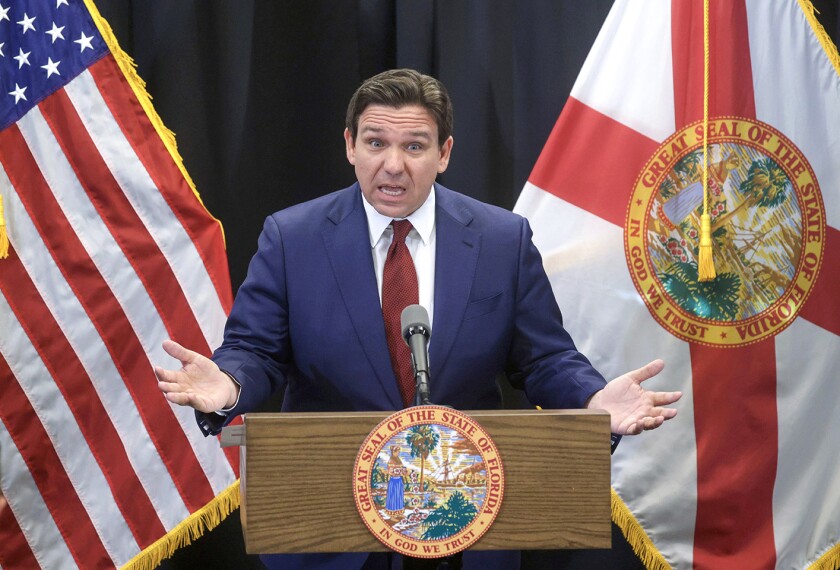
Florida will have one of the country’s most restrictive social media bans for minors under a bill signed by Gov. Ron DeSantis on March 25.
The law, which will take effect on Jan. 1, prohibits social media platforms from allowing children younger than 14 to have an account. For 14- and 15-year-olds, social media platforms must require parental permission before allowing them to set up accounts.
Addressing adolescents’ worsening mental health recently has become a top priority for school, district, state, and federal leaders as young people struggle with record-high rates of depression and anxiety.
Much of the conversation around the mental health crisis has focused on young people’s constant use of cellphones and social media. Some states, including Florida, already ban or are considering banning cellphones in classrooms. More than 200 districts have sued major social media companies over the youth mental health crisis.
“We dug into the research showing the negative effects of social media on children, and it directly pointed to the addictive features these companies develop to keep our kids hooked,” Florida House Speaker Paul Renner said in an email statement to Education Week.
Florida’s social media ban doesn’t target specific platforms. Instead, the bill says that the law applies to any platform where at least 10 percent of daily active users are children younger than 16 who use it for two hours or more a day; that uses “addictive” features, such as infinite scrolling; and that uses algorithms that analyze user data to handpick content for users.
Most social media platforms already state in their policies that children younger than 13 aren’t allowed to create accounts. But the law requires these platforms to actually verify the age of its users. It leaves it up to the companies to determine how to meet the requirements. If a social media platform is found in violation, the state Department of Legal Affairs may fine the platform up to $50,000 per violation. Parents or caregivers could also file lawsuits against the platforms.

Similar bans in other states have run into legal issues
Arkansas, California, Ohio, and Utah passed similar bans last year on kids using social media, but none of those laws has taken effect yet because of legal issues. Federal judges have stopped the legislation from taking effect over concerns that the bans violate kids’ free speech rights and that age verifications are unconstitutional.
Renner said during the bill signing that he expects social media companies to file lawsuits, but he’s confident the state will beat them, the Associated Press reported.
Carl Szabo, the vice president and general counsel for NetChoice, called the law “unconstitutional,” because it “infringes on Floridians’ First Amendment rights,” in an email statement to Education Week.
It’s “bad policy because of the data collection on Floridians by online services it will in effect require. This will put their private data at risk of breach,” Szabo added.
NetChoice is a trade association of online businesses that advocate free expression and free enterprise on the internet. It includes TikTok, Meta (the parent company of Instagram and Facebook), and Snap (the parent company of Snapchat). The organization has filed lawsuits against similar legislation in Arkansas, California, and Utah.
The Florida law has a contingency plan to put in motion if a court decides to prohibit the enforcement of the section that requires parental consent for 14- and 15-year-olds to use social media. It says in that case, the law will just prohibit anyone 15 years old or younger from using social media.
“It almost seems like they [the state] were preemptively punishing [anyone who tries to file a lawsuit], saying ‘All right, if you won’t give us this, we’re going to be even stricter,’” said Amelia Vance, the president of the Public Interest Privacy Center, which advocates effective, ethical, and equitable privacy safeguards for all children and students.

‘We just don’t know’ if bans work
Vance is skeptical that Florida’s ban will make children safer online. Kids will find ways around these restrictions if they really want to be on those platforms, she said.
“The approach that is most likely going to be effective here is the one that says, ‘OK, kids are going to be online. Let’s give them special protections when they are,” Vance said. The state’s “Digital Bill of Rights,” which passed last year and takes effect in July, would probably be more effective because it puts in place protections around what data can be collected and places limits around how the data can be used, she said.
Kris Perry, the executive director of Children and Screens, a nonprofit organization that seeks to understand and address the implications of digital media on child development, said a ban “will protect kids from the harms related to social media,” but it will also prevent them from “accessing the benefits.”
“It’d be really important to study whether or not the ban accomplished its intended goal,” Perry said. “We just don’t know, without studying the aftereffects of whether that was an effective strategy.”
In Florida, the statewide ban on students using cellphones during instructional time that went into effect last year has had a positive impact in some schools on student behavior and learning, according to Renner.
“We are hopeful that steering kids toward the real world and away from a warped digital world will result in even more positive outcomes [for student learning],” Renner said in the statement to Education Week.

Equipping students with the right skills
For students, the focus shouldn’t be on restriction, said Ava Havidic, 18, a senior at Millennium 6-12 Collegiate Academy in Broward County, Fla.
“When you ban things or when you restrict things, sometimes, it’s going to be like a green light for students to say, ‘OK, how can I override that? How can I find my way to use it still?’” said Ava, who serves as a student adviser for the Broward County school board.
The focus should instead be on “explaining why it’s important to limit usage” and “formulating a mindset at a young age so they can learn how to use it correctly,” she said.
Kids will become adults, and they’re going to be using these platforms, and if we limit their use and don’t teach them the right way to use it, “they’re not going to be prepared,” she added.



