One of the nation’s largest Democratic-led states will participate in the new federal private school choice program included in the sweeping domestic policy bill signed into law last year by President Donald Trump.
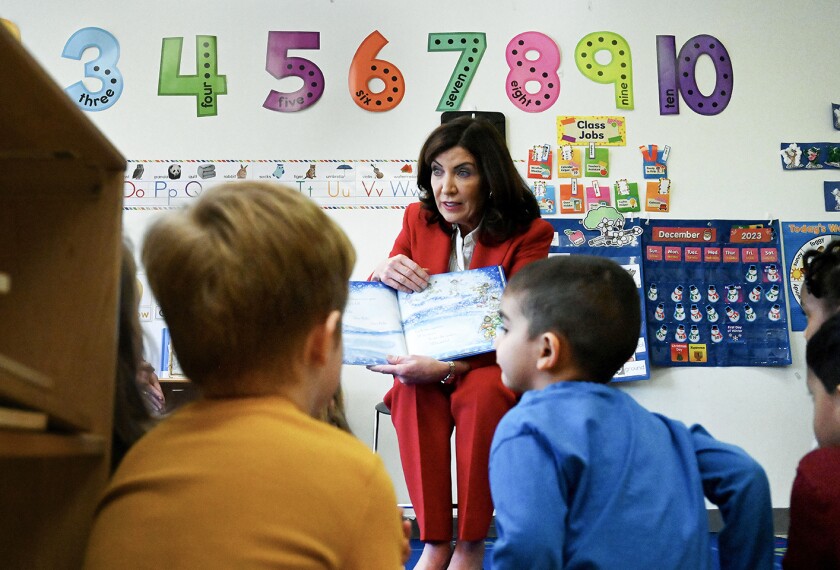
New York Gov. Kathy Hochul confirmed this week that she intends to opt her state in to the program, which allows taxpayers to claim dollar-for-dollar tax credits in exchange for donations to organizations that award private school scholarships. The policy takes effect next year.
Hochul “is supportive of the federal tax credit scholarship and its potential to help New York students and schools,” a spokesperson said in an email to Education Week. “Our office awaits information from the federal government on the program and will thoroughly review the details of the policy for poison pills that could harm New York’s education system.”

Hochul’s support for the program makes her among the first Democratic governors to choose to participate. It’s also the latest example of how the federal government’s first nationwide foray into directing taxpayer funds to families so they can enroll in private schools is dividing Democratic governors, who have to decide whether to sign their states up.
Under the law passed last summer, individual taxpayers can claim a federal tax credit of up to $1,700 for donations to nonprofit organizations that then award scholarships to K-12 students who can use them to attend private schools.
The scholarships can also cover costs for public school students—such as tutoring, technology, and after-school programs—but most expect the bulk of funds to flow to students attending private schools.
Estimates of the program’s cost vary, but congressional scorekeepers project taxpayers will claim $500 million in tax credits in 2027, an amount that will grow to $4.4 billion by 2034. (By comparison, Title I, the largest federal formula fund for public schools, is worth about $18 billion annually.)
Governors each year must tell the IRS they’re opting in before nonprofits can give out the tax credit-backed scholarships in their states, and governors must tell the IRS which organizations in their states are eligible to award the money.
Taxpayers from any state are eligible to claim the credits, though their contributions to scholarship-granting organizations would have to cross state lines if their state isn’t participating.
Students whose family income does not exceed 300% of their area’s median gross income—a broad pool of potential recipients—will be eligible to receive scholarships as long as their state opts into the scholarship program. The federal law does not specify the size of scholarships awarded.
The American Federation for Children, a school choice advocacy group, applauded Hochul’s move and welcomed the arrival of private school choice in a state that doesn’t currently have any state programs that direct public funds toward private school tuition.
“We celebrate alongside every family who will soon, finally, have a chance to access an education that meets their children’s needs,” the federation’s CEO, Tommy Schultz, said in a statement.
Melinda Person, president of the 700,000-member New York State United Teachers union, said, “public dollars belong in public schools.
“Vouchers—by any name—take money away from neighborhood schools and hand it to private institutions that don’t answer to the public,” she said in a statement. “New Yorkers have rejected this approach before, and we sincerely hope that once the full details of President Trump’s voucher scheme emerge, it will be clear state leadership should reject it again.”
Federal program brings private school choice to new states
With Hochul’s announcement, New York becomes the 31st state on track to participate in the new federal choice program, according to Education Week’s tracker of state decisions.
She’s only the third Democratic governor to affirmatively say she intends to opt in, following Gov. Jared Polis of Colorado, who has emerged as an enthusiastic backer of the policy, and Gov. Josh Stein of North Carolina, who last summer vetoed legislation to opt his state in but said he intends to opt in on his own once the federal government issues regulations on how the program will work.
The Democratic governors of Minnesota and Wisconsin have both said their states won’t participate, and Democratic governors in Kansas and Kentucky recently vetoed legislation opting their state in to the program only to have their vetoes overridden by Republican-dominated legislatures.
Only one Republican governor, Phil Scott of Vermont, has yet to announce his intentions.
Many Democratic governors have said they’re awaiting regulations from the Internal Revenue Service spelling out more details on how the program will operate—and how much control states could have over how it runs.
Could they set accountability and nondiscrimination requirements for participating private schools, for example, or ensure that a particular percentage of scholarship money goes to public school students?
The IRS, however, has indicated the regulations are unlikely to give states wide discretion. Its regulations are expected in the coming months.
Even if Democratic governors have concerns about the program, more have been moving toward participation.

Three Democratic governors last year—Josh Green of Hawaii, Michelle Lujan Grisham of New Mexico, and Tina Kotek of Oregon—initially told Education Week their states would not participate. But they said earlier this year, after Colorado’s Polis opted in, that they’re reconsidering and that they hadn’t made up their minds.
While teachers’ unions normally aligned with Democrats have remained opposed to the program, some Democratic voices have been urging governors from their party to participate. Arne Duncan, former President Barack Obama’s first education secretary, last fall called opting in to the federal program a “no-brainer” in a Washington Post op-ed.
With New York now on track to join, the federal program will bring private school choice to at least six states that don’t currently have their own programs directing public funds to private schools. Alaska, Colorado, Kentucky, Nebraska, and North Dakota are the others.