School Choice & Charters Tracker

Federal School Choice: Which States Are Opting In?

Education Week is tracking state decisions on the first federal tax-credit scholarship.
By Matthew Stone, Brooke Schultz & Lynn (Yunfei) Liu — August 27, 2025 | Updated: October 09, 2026 3 min read
Penelope Koutoulas holds signs supporting school choice in a House committee meeting on education during a special session of the state legislature Tuesday, Jan. 28, 2025, in Nashville, Tenn.
  • Save to favorites
  • Print

Updated: This tracker has been updated with comments from governors in response to the IRS’ release of regulations governing the federal scholarship tax credit program.

State officials must decide if they’ll participate in the first major federal program that bankrolls K-12 scholarships for private schools and a range of expenses at public schools through the tax code.

Congress included a tax-credit scholarship in the One, Big Beautiful Bill Act, allowing taxpayers to claim tax credits in exchange for donations to organizations that grant private school scholarships and scholarships covering some expenses tied to public schools, such as tutoring and after-school programs.

Until now, all major school choice programs have been state-level initiatives. But the federal tax-credit scholarship forces all states and the District of Columbia to decide on school choice, whether they currently have a choice program of their own or don’t.

Thirty-one states have opted in to the federal tax-credit scholarship or signaled that they will, and three governors have said their states won't participate. Sixteen governors and the mayor of the District of Columbia have not formally decided or haven't announced decisions, according to an Education Week analysis.

Two governors who initially said they would not opt in have since reconsidered their stances and said they haven't made decisions on participating.


State decisions on opting in so far

Under the new law, individual taxpayers can claim a dollar-for-dollar tax credit for up to $1,700 in donations to nonprofit organizations that award scholarships so K-12 students can attend private schools. Scholarships can also pay for some expenses tied to public schools, with the law naming tutoring, technology, uniforms, and extended-day programs.

Students whose family income does not exceed 300% of their area’s median gross income—a threshold that ranges from families earning more than $500,000 in Westchester County, N.Y., to about $114,000 in Wolfe County, Ky.—are eligible to receive scholarship funds as long as their state opts into the scholarship program. The federal law does not specify the size of scholarships awarded.

The scholarships could cover a range of expenses. In addition to tuition at private schools, including religious schools, they could pay for tutoring, school uniforms, technology, after-school programs, transportation, and services for students with disabilities. Scholarships can cover “a broad set of expenses incurred in connection with or required by any K-12 public, private, or charter school,” the U.S. Department of Education said in a January 2026 fact sheet on the program.

Taxpayers can claim credits starting in the 2027 tax year, and the Internal Revenue Service on Dec. 12, 2025, formally launched the process allowing states to opt into the program. The Department of the Treasury on Oct. 1, 2026, released temporary regulations to govern the program’s first year and proposed rules for the program to be finalized later on.

The law generally charges governors with deciding whether to enroll their states in the program, but lawmakers in some states have taken action to enroll their states, overriding governors’ vetoes in Kansas, Kentucky, and North Carolina.

To date, all but one Republican-led state has taken action to opt in. Republican governors expect to use the federal offering to complement their own state programs or, in the few Republican-led states without private school choice, to create their own.

Democratic governors have been more skeptical, with many saying in early October 2026 that they’re still in the process of reviewing the federal regulations before deciding. A handful have said they’re looking into how the funding could help low-income students or support public school students.

Partisan breakdown of state decisions

Read Education Week’s coverage of the federal school choice program

For more information on state private school choice programs, visit our tracker of state programs.

Contact information

For media or research inquiries about this data, contact library@educationweek.org.

How to cite this page

Federal School Choice: Which States Are Opting In? (2025, Aug. 27). Education Week. Retrieved Month Day, Year from https://www-edweek-org.ezproxy.baylor.edu/policy-politics/federal-private-school-choice-which-states-are-opting-in/2025/08


Reporting/analysis: Holly Peele

This tracker was previously developed or maintained by: Brooke Schultz

Coverage of strategies for advancing the opportunities for students most in need, including those from low-income families and communities, is supported by a grant from the Walton Family Foundation, at www.waltonk12.org. Education Week retains sole editorial control over the content of this coverage.

Events

This content is provided by our sponsor. It is not written by and does not necessarily reflect the views of Education Week's editorial staff.
Sponsor
School Climate & Safety Webinar
There But Not Present: Rethinking Student Engagement
Learn how to recognize the early signs of disengagement and what the behavioral science reveals about which interventions actually work.
Content provided by Frontline Education
Teacher Preparation Webinar What Teacher Education Should Look Like in the Age of AI
Explore the current trends around the use of AI in teacher preparation and continuing education with data from the EdWeek Research Center.
English Learners Webinar How Can School Districts Better Support English Learners With Disabilities?
Join this webinar to hear recent findings from the EdWeek Research Center and discover practical strategies for improvement.

EdWeek Top School Jobs

Teacher Jobs
Search over ten thousand teaching jobs nationwide — elementary, middle, high school and more.
View Jobs
Principal Jobs
Find hundreds of jobs for principals, assistant principals, and other school leadership roles.
View Jobs
Administrator Jobs
Over a thousand district-level jobs: superintendents, directors, more.
View Jobs
Support Staff Jobs
Search thousands of jobs, from paraprofessionals to counselors and more.
View Jobs

Read Next

School Choice & Charters Explainer New Rules for Federal School Choice: What You Need to Know
Proposed rules from the IRS offer some details on how the first nationwide school choice program will work.
MINNEAPOLIS, MN, January 22, 2026: Students move through the halls at Washburn High School in Minneapolis, MN.
The Trump administration has released proposed regulations outlining how the first nationwide school choice program will operate when it launches next year. The regulations leave some major questions unaddressed but clarify other aspects for the tax-credit scholarship program.
Caroline Yang for Education Week
School Choice & Charters Federal Education Tax Credit Rules Are Finally Here. What We Know So Far
The Treasury Department unveiled regulations governing a massive infusion of education funding nationwide.
5 min read
The tax credit program would allow individuals who donate up to $1,700 to a scholarship granting organization to receive a dollar-for-dollar federal income tax credit in exchange. Pictured are students at Northeast Elementary located at 1024 Fleming Ave. in Jackson on Aug. 20, 2025.
Students at Northeast Elementary School in Jackson, Mich., on Aug. 20, 2025. A tax-credit scholarship program launching in January will allow individuals who donate up to $1,700 to a scholarship granting organization to receive a dollar-for-dollar federal income tax credit. Those SGOs can give out awards to cover private school tuition as well as some expenses for public school students.
Abra Richardson/mlive.com via TNS
School Choice & Charters Opinion What Do Parents Look for in a School?
Test scores aren’t the whole story. The CEO of GreatSchools talks about what parents want.
•
5 min read
The United States Capitol building as a bookcase filled with red, white, and blue policy books in a Washington DC landscape.
Luca D'Urbino for Education Week
School Choice & Charters Microschools Are Spreading. Some School Districts Have Opened Their Own
Districts see the small learning communities as an alternative for families that may otherwise leave.
8 min read
MLP 5851 2
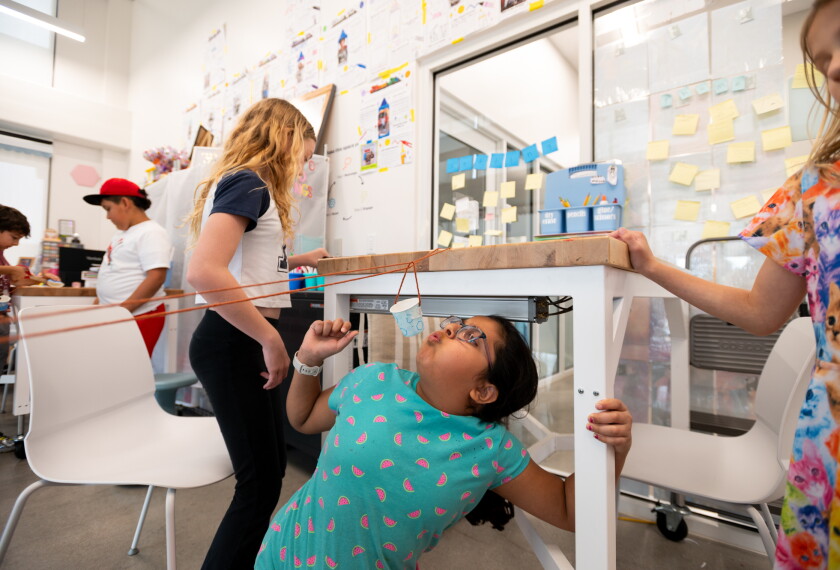
Daisy Wisbey, 11, and Eleanor Mukiri, 10, work on an engineering challenge at Creative Minds in Wichita, Kan., on Sept. 15, 2026. The Wichita public schools runs Creative Minds as a microschool, in which students from multiple grades learn together in a project-based learning format. Wichita is among a handful of public school districts that have begun their own microschools.
Melissa Lukenbaugh for Education Week