
Education Funding

Education Dept. Sees Small Cut in Funding Package That Averted Government Shutdown

By Matthew Stone — March 27, 2024 | Updated: March 28, 2024 3 min read
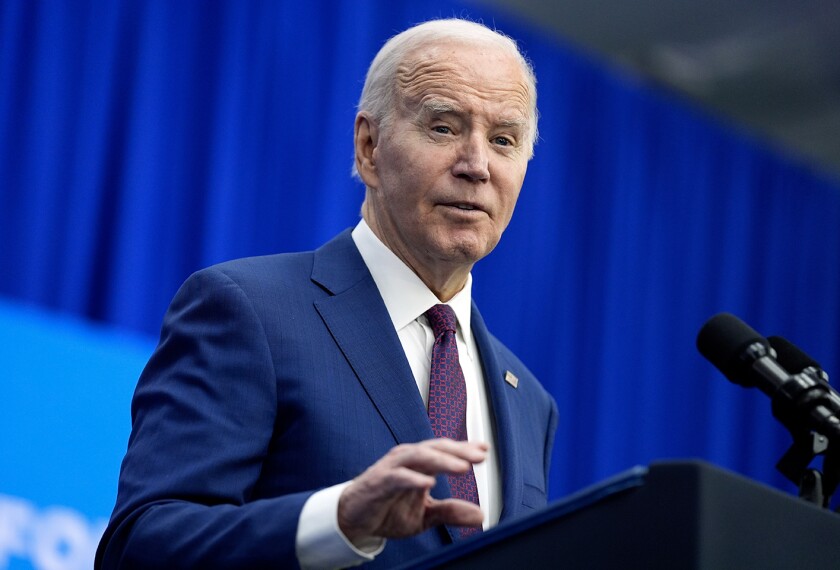
President Joe Biden delivers a speech about healthcare at an event in Raleigh, N.C., on March 26, 2024.
  • Save to favorites
  • Print

The $1.2 trillion funding package that will keep the federal government operating through September includes a cut of about $100 million to the U.S. Department of Education’s budget even as it provides small increases to key K-12 programs and holds the line on others.

President Joe Biden signed the funding package into law over the weekend after it passed the House on March 22, and the Senate early the next day, averting a partial shutdown. The package combines six annual spending bills to pay for different parts of the federal government, which had been operating on stopgap measures in the absence of a final budget for the 2024 fiscal year that began last October.

The Education Department will receive $79.1 billion for the fiscal year that lasts through Sept. 30.

That’s about $100 million less than the department’s final budget for the 2023 fiscal year, a drop of about 0.2 percent. And it’s far short of the $90 billion Biden had requested for the department in his initial 2024 budget proposal, which he unveiled a year ago, in March 2023.

But even with the overall cut, lawmakers provided increases of $20 million each to Title I grants that support services for low-income students and Individual with Disabilities Education Act, or IDEA, funds that help schools cover special education costs. Title I and IDEA are the two largest federal funds for K-12 schools.

The $20 million increases would bring Title I funding to just above the $18.4 billion allocated to the program in 2023 and bring IDEA funding to just above its 2023 level of $14.2 billion.

An Education Department spokesperson said the year-over-year differences are largely the result of mid-year budgets cuts and earmarks—funding lawmakers designated for specific projects.

The federal government typically accounts for less than 10 percent of the money spent each year on public education nationwide.

The Republican-controlled House had initially passed deep cuts to Title I and the elimination of funds that support English learners and teacher preparation, recruitment, and professional development. The spending bills that became law preserve that funding, according to a summary from the Senate’s appropriations committee.

Outside of the Education Department budget, the spending bill increases funding for Head Start by $275 million over last year, bringing total financing for the early-childhood program this year to $12.3 billion.

The additional money is meant to help the program address staffing shortages as it experiences its highest turnover in two decades, according to the appropriations committee summary. The Biden administration proposed a new rule in the fall that seeks to raise Head Start teacher pay in the coming years to bring it closer to K-12 teacher salaries, a change that will require additional funding for Head Start programs, which have been serving fewer children in recent years.

In his initial 2024 budget proposal, Biden had sought a $1.1 billion increase over 2023 for the program that serves children living at or near the federal poverty level.

See Also

Close cropped photo of a young child putting silver coins in a pink piggy bank.
iStock/Getty

The newly approved spending package also includes funding in the Defense Department budget to double enrollment in that agency’s prekindergarten programs for children of military members.

The National Association of Secondary School Principals welcomed the new budget.

It “avoids painful cuts while increasing the resources for high-needs students like mine,” Chris Young, the principal of North Country Union High School in Newport, Vt., and the principal association’s advocacy champion, said in a statement.

Biden unveiled his budget proposal for the 2025 fiscal year, which begins Oct. 1, before lawmakers had passed the final 2024 spending package.

In the 2025 budget proposal—which is unlikely to pass a divided Congress as is—he requested $82 billion for the Education Department, representing a smaller increase than he’d proposed in past years to stay within spending caps the president negotiated last year with then-House Speaker Kevin McCarthy to avert a default on the national debt. Those spending caps also apply to the 2024 funding bills.

Biden’s 2025 budget proposal includes increases for Title I and IDEA, as well as an $8 billion academic-acceleration grant program meant to help districts maintain learning-recovery initiatives they’ve launched in recent years with the help of $190 billion in federal COVID-relief funds, the last round of which are set to expire Sept. 30.
See Also

President Joe Biden delivers remarks on lowering prices for American families during an event at the YMCA Allard Center on March 11, 2024, in Goffstown, N.H.
President Joe Biden delivers remarks on lowering prices for American families during an event at the YMCA Allard Center on March 11, 2024, in Goffstown, N.H. Biden's administration released its 2025 budget proposal, which includes a modest spending increase for the Education Department.
Evan Vucci/AP
Education Funding Biden's Budget Proposes Smaller Bump to Education Spending
Libby Stanford, March 11, 2024
7 min read

Events

This content is provided by our sponsor. It is not written by and does not necessarily reflect the views of Education Week's editorial staff.
Sponsor
Recruitment & Retention Webinar
Hiring, Retention, and Fill Rates: A Data-Driven Sub Strategy
Explore what keeps substitutes coming back and hear how one district rebuilt its substitute hiring process and improved its fill rate.
Content provided by Frontline Education
Early Childhood K-12 Essentials Forum Early Childhood Education: Building Essential Skills for Success
Join this free virtual event to examine the biggest challenges in supporting young children, from preschool through elementary school. 
This content is provided by our sponsor. It is not written by and does not necessarily reflect the views of Education Week's editorial staff.
Sponsor
Student Absenteeism Webinar
Attendance Isn't an Attendance Problem
Boost attendance by strengthening relationships, belonging, and support with practical strategies from Doug Fisher & Nancy Frey.
Content provided by Corwin

EdWeek Top School Jobs

Teacher Jobs
Search over ten thousand teaching jobs nationwide — elementary, middle, high school and more.
View Jobs
Principal Jobs
Find hundreds of jobs for principals, assistant principals, and other school leadership roles.
View Jobs
Administrator Jobs
Over a thousand district-level jobs: superintendents, directors, more.
View Jobs
Support Staff Jobs
Search thousands of jobs, from paraprofessionals to counselors and more.
View Jobs

Read Next

Education Funding Averting a Shutdown, Congress Punts Federal Spending Decisions to December
Federal funding talks will continue into December as Congress agrees to avoid a shutdown.
2 min read
Speaker of the House Mike Johnson, R-La., arrives for a closed-door meeting with Republican lawmakers as he prepares for a vote on a stopgap spending bill to keep the federal government fully funded through early December, avoiding the possibility of a shutdown before the midterm elections, at the Capitol in Washington, Tuesday, Sept. 1, 2026.
Speaker of the House Mike Johnson, R-La., arrives for a closed-door meeting with Republican lawmakers at the U.S. Capitol on Sept. 1, 2026, as he prepares for a vote on a stopgap spending bill to keep the federal government fully funded through early December, avoiding the possibility of a shutdown before the midterm elections. The continuing resolution carries over the current year's funding levels for education programs into the first two months of the federal fiscal year that starts Oct. 1.
J. Scott Applewhite/AP
Education Funding Education Department Will Keep Sending Most K-12 Funds Through Its Own System
The agency will send formula funds through its own system again despite program shifts to other agencies.
5 min read
A sign from the General Services Administration is posted outside of the Department of Education headquarters in Washington, D.C. on Friday, July 17, 2026.
A sign installed by the General Services Administration is posted outside the Department of Education headquarters in Washington on July 17, 2026. Despite shifting its programs to other agencies, the Education Department will send billions of dollars in formula funds for schools through its own grants portal on Oct. 1, rather than a portal run by the Department of Labor.
Eric Lee for Education Week
Education Funding Video What's in Store for School Funding for 2026-27?
A new education tax credit, federal budget negotiations, and more are in store.
The U.S. Capitol building in Washington, D.C. on Friday, July 17, 2026.
Eric Lee for Education Week
Education Funding Trump's Education Department Is Letting Tens of Millions of Dollars Expire
Education Week found the agency didn't spend its full budget last year and appears on track to do so again.
10 min read
A collage-style illustration of images of the U.S. Department of Education building, the U.S. Capitol building, and dollar bills on top of a wooden school desktop with a pencil on it and a school bus underneath. The dollar bills appear to have been punched out with a hole punch in a few areas, and those missing circles are sprinkled on the desk and school bus below.
Illustration by Emily Wright for Education Week + Getty
