School Choice & Charters Photo Essay

Nurturing Success at a Los Angeles Charter School

By Education Week Photo Staff — June 28, 2016 2 min read
  • Save to favorites
  • Print

Photographer Patrick Fallon writes about his experiences photographing a charter school in Los Angeles, and how it contrasts with the high school he attended.
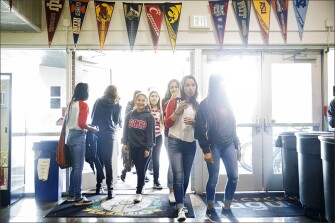
Students arrive for classes at Alliance Collins Family College-Ready High School, a public charter school in Huntington Park, Calif.

On my recent assignment for Education Week that chronicled the 25th anniversary of the charter schools movement, I couldn’t help but think of some of the major contrasts of my own large public high school experience and that of the students at Alliance Collins Family College-Ready High School.

The high school that I graduated from in 2007 – Redondo Union High School in Redondo Beach, Calif. – is a massive beast of a campus. It’s the second-largest in area in California at 56 acres—with over 2,700 students. By comparison, the Alliance charter school that I visited has a population of less than a quarter of that and operates inside a shuttered shoe factory in an industrial part of the Los Angeles area. The downtown skyline looms on the northern horizon.

Just a few miles north of the Alliance Collins Family College-Ready High School, the skyline of downtown Los Angeles stands at sunset as seen from a bridge overlooking the Los Angeles River.

The 100-year-old Redondo campus has views of the Pacific Ocean. It was there where I started working with photography on the school’s yearbook and newspaper staffs, and realized that photographing people and news events could be my job. Friday nights in the fall were spent covering football games and talking to newspaper photographers – some of whom I now work alongside covering events for competing publications.

While some skylights in the campus at Alliance Collins funneled natural light into the hallways, I felt a little starved for natural light and windows as I walked around the school. Going outside for science experiments or meal breaks proved to be a welcome reprieve. Every so often, freight trains rumbled and roared from the tracks that run parallel to the school.

But the lack of natural light and noisy interruptions didn’t detract from the strong intimacy I observed among the students, staff and administrators. While I never felt “lost” at Redondo High, I could easily see how other students there might feel that way. The closer environment of Alliance Collins helps keep everyone connected, focused and more accountable.

Student Krystal Lopez completes a class assignment about Freedom Riders in a U.S. history class at Alliance Collins.
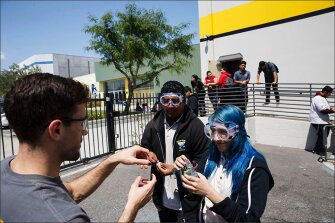
Alberto Esparza and Valerie Flores, right, prepare a lab experiment with teacher Matt Duda, left, during chemistry class.
Counselor Lani E. Advokat discusses the college application process with junior Susana Delgadillo.
A poster pays tribute to parents who have become actively involved in their child’s education at Alliance Collins. The school serves mostly low-income, Latino students.

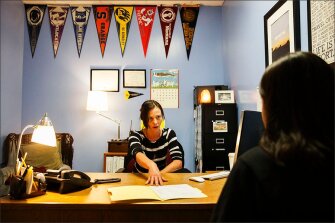
I was most impressed by the high college acceptance rate of the 2016 class at Alliance Collins: Every graduating student was accepted into a 4-year university. There was no shortage of posters and banners supporting students in this quest – a visual representation of how the school creates an environment and an expectation that students will go onto, and be ready for college.

It was this very explicit expectation for success that tied both schools together for me. With the right environment and resources, hopefully the future of all students can be shaped to grow positively in high school and enable them to explore their individual talents.

Related Tags:

A version of this article first appeared in the Full Frame blog.

Events

This content is provided by our sponsor. It is not written by and does not necessarily reflect the views of Education Week's editorial staff.
Sponsor
School Climate & Safety Webinar
There But Not Present: Rethinking Student Engagement
Learn how to recognize the early signs of disengagement and what the behavioral science reveals about which interventions actually work.
Content provided by Frontline Education
Teacher Preparation Webinar What Teacher Education Should Look Like in the Age of AI
Explore the current trends around the use of AI in teacher preparation and continuing education with data from the EdWeek Research Center.
English Learners Webinar How Can School Districts Better Support English Learners With Disabilities?
Join this webinar to hear recent findings from the EdWeek Research Center and discover practical strategies for improvement.

EdWeek Top School Jobs

Teacher Jobs
Search over ten thousand teaching jobs nationwide — elementary, middle, high school and more.
View Jobs
Principal Jobs
Find hundreds of jobs for principals, assistant principals, and other school leadership roles.
View Jobs
Administrator Jobs
Over a thousand district-level jobs: superintendents, directors, more.
View Jobs
Support Staff Jobs
Search thousands of jobs, from paraprofessionals to counselors and more.
View Jobs

Read Next

School Choice & Charters Explainer New Rules for Federal School Choice: What You Need to Know
Proposed rules from the IRS offer some details on how the first nationwide school choice program will work.
MINNEAPOLIS, MN, January 22, 2026: Students move through the halls at Washburn High School in Minneapolis, MN.
The Trump administration has released proposed regulations outlining how the first nationwide school choice program will operate when it launches next year. The regulations leave some major questions unaddressed but clarify other aspects for the tax-credit scholarship program.
Caroline Yang for Education Week
School Choice & Charters Federal Education Tax Credit Rules Are Finally Here. What We Know So Far
The Treasury Department unveiled regulations governing a massive infusion of education funding nationwide.
5 min read
The tax credit program would allow individuals who donate up to $1,700 to a scholarship granting organization to receive a dollar-for-dollar federal income tax credit in exchange. Pictured are students at Northeast Elementary located at 1024 Fleming Ave. in Jackson on Aug. 20, 2025.
Students at Northeast Elementary School in Jackson, Mich., on Aug. 20, 2025. A tax-credit scholarship program launching in January will allow individuals who donate up to $1,700 to a scholarship granting organization to receive a dollar-for-dollar federal income tax credit. Those SGOs can give out awards to cover private school tuition as well as some expenses for public school students.
Abra Richardson/mlive.com via TNS
School Choice & Charters Opinion What Do Parents Look for in a School?
Test scores aren’t the whole story. The CEO of GreatSchools talks about what parents want.
•
5 min read
The United States Capitol building as a bookcase filled with red, white, and blue policy books in a Washington DC landscape.
Luca D'Urbino for Education Week
School Choice & Charters Microschools Are Spreading. Some School Districts Have Opened Their Own
Districts see the small learning communities as an alternative for families that may otherwise leave.
8 min read
MLP 5851 2
Daisy Wisbey, 11, and Eleanor Mukiri, 10, work on an engineering challenge at Creative Minds in Wichita, Kan., on Sept. 15, 2026. The Wichita public schools runs Creative Minds as a microschool, in which students from multiple grades learn together in a project-based learning format. Wichita is among a handful of public school districts that have begun their own microschools.
Melissa Lukenbaugh for Education Week