Dual-Credit Programs Are Growing, But Do They Reach the Students Who Need Them Most?
College & Workforce Readiness What the Research Says

Dual-Credit Programs Are Growing, But Do They Reach the Students Who Need Them Most?

By Sarah D. Sparks — October 10, 2023 2 min read
Image shows empty desks in a classroom.
  • Save to favorites
  • Print

Dual-credit programs, which allow students to undertake college coursework in high school, have expanded rapidly in the last decade, but in most schools they remain a patchwork of different courses. That leads both to inequitable access and uncertainty about whether the college credits students earn will actually further their progress toward earning their chosen degrees.

That’s the conclusion of a new report released Tuesday by the Community College Research Center at Columbia University Teachers College, which tracks dual-credit programs in public schools. One in 5 community college students now attends as part of a dual-credit program.

As of 2020, more than 4 in 5 public high schools were partnering with higher education institutions to offer college credit to their students, the CCRC report finds. But only about 1 in 5 school districts provided equitable access to dual credit.
For example, white students made up more than 60 percent of dual-credit students in 2018, but only about half of all public school students. Black students, by contrast, accounted for nearly 15 percent of public school students but less than 9 percent of dual-enrollment students in 2018.

“We’ve heard over and over again that dual enrollment [programs] are too often programs of privilege,” said John Fink, a co-author of the report and a senior research associate for the CCRC. He noted that many schools that offer dual credit have prerequisites and do not explicitly advise students in how the credits could help them in careers. As a result, first-generation, college-going students are less likely to enter the dual-credit programs or choose useful courses.

“We need to build and tap into students’ motivation,” Fink said, “because if you’re going to broaden access to dual enrollment, you also have to up the supports to make sure students succeed and do well in these courses.”

The report finds more than 400 community college-high school partnerships in 16 states have started to develop more systemic approaches to dual credit, called “dual enrollment equity pathways.” In these programs, educators in both K-12 and higher education work to identify the most needed courses for popular careers, then work together to identify students and provide supports for them to both take dual-credit courses and then go on to matriculate into higher education.

Fink and his colleagues recommended four key strategies for improving the programs and making them more equitable:

  • Outreach: Instead of simply providing courses, districts and higher education institutions should actively recruit students from underrepresented groups.
  • Alignment: Ensure the credits students can earn apply toward degrees in fields that interest them.
  • Advising: Couple access to college-credit courses with supports for students to explore different careers and plan and apply for college and financial aid.
  • High-quality instruction. Provide good teaching and academic support, particularly for first-generation college students.
Events

This content is provided by our sponsor. It is not written by and does not necessarily reflect the views of Education Week's editorial staff.
Sponsor
College & Workforce Readiness Webinar
From Exposure to Experience: Designing Accessible Work-Based Learning
Learn how schools can create meaningful experiences that help every student build skills, connections, and a clearer path to their future.
Content provided by Project Lead The Way
This content is provided by our sponsor. It is not written by and does not necessarily reflect the views of Education Week's editorial staff.
Sponsor
School & District Management Webinar
A Tale of Two School Districts: Forecasting Enrollment
Forecasting enrollment is hard. Here’s how two different districts are navigating times of change with data that considers the whole picture.
Content provided by Zonda Education
Reading & Literacy K-12 Essentials Forum Strategies to Create a Culture of Reading in Schools
Join this free virtual event to learn how teachers and school district leaders ensure students are reading enough.

EdWeek Top School Jobs

Teacher Jobs
Search over ten thousand teaching jobs nationwide — elementary, middle, high school and more.
View Jobs
Principal Jobs
Find hundreds of jobs for principals, assistant principals, and other school leadership roles.
View Jobs
Administrator Jobs
Over a thousand district-level jobs: superintendents, directors, more.
View Jobs
Support Staff Jobs
Search thousands of jobs, from paraprofessionals to counselors and more.
View Jobs

Read Next

College & Workforce Readiness Q&A Reading, Writing, and Math Skills Are Top Priorities in This CTE Program
How these teachers are connecting the dots between academic and technical skills.
4 min read
Cass Career Center
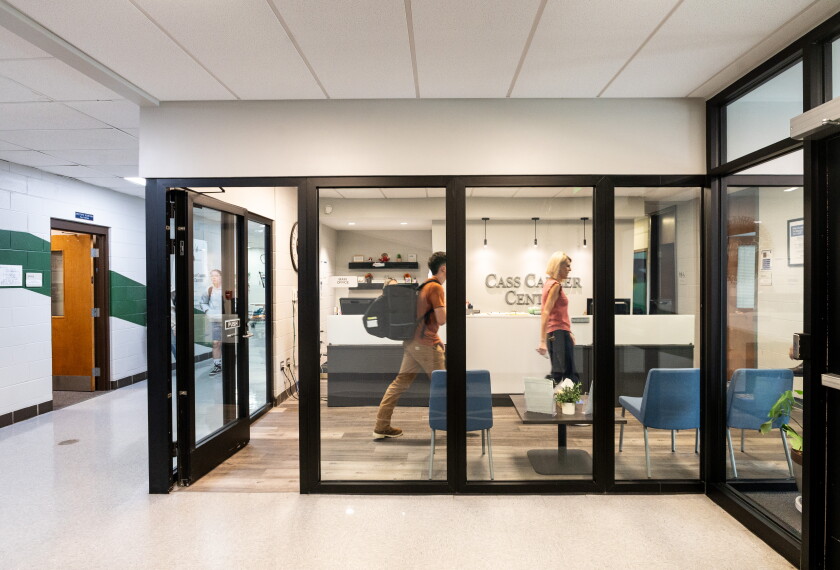
Assistant Director, Nicole Tews, walks a student through the administration office at the Cass Career Center in Harrisonville, Mo., on September 29, 2026. The center has a math and an English teacher who are integrated into students' industry-specific career programs.
Melissa Lukenbaugh for Education Week
College & Workforce Readiness Q&A Dual Enrollment Is Surging. Here's How High Schools Can Get it Right
More than 3 million high school students took a college course last year.
3 min read
Macomb Community College's South Campus in Warren, Mich. off of 12 Mile Road on Oct. 15, 2026.
Macomb Community College's South Campus in Warren, Mich., is shown on Oct. 15, 2026. In Michigan, 16 percent of community college students are high schoolers. Nationwide, dual enrollment now tops 3 million students.
Miles Oates/mlive.com via TNS
College & Workforce Readiness The CTE Program Answering the Question ‘Why Do I Need Math to Be a Firefighter?’
Integrating academic learning into career and technical education comes with challenges.
13 min read
Cass Career Center
Layton Heaper, a senior in the welding program at the Cass Career Center in Harrisonville, Mo., works on a project on Sept. 29, 2026. Through the school's integrated academics program, students learn and apply English and math skills related to future careers.
Melissa Lukenbaugh for Education Week
College & Workforce Readiness As Students Explore Alternatives to College, Are Counselors Ready to Help Them?
A new survey finds growing interest in non-degree pathways post-graduation, but schools are struggling to keep up.
3 min read
Kendall Gray (left) and Gala Davis (right), both guidance counselors, catch up and talk in Davisí office at South Oak Cliff High School in Dallas on March 6, 2025.
Kendall Gray, left, and Gala Davis, both school counselors, talk in Davis' office at South Oak Cliff High School in Dallas on March 6, 2025. A new survey polls school counselors about student career readiness.
Liz Rymarev/The Dallas Morning News via TNS