Special Report
Reading & Literacy

Editor’s Note: Learning to Read in a Digital Age

By The Editors — November 09, 2016 1 min read
  • Save to favorites
  • Print

There has never been a generation of young people more immersed in digital media than this one. From computers to smartphone apps to e-books, electronic media has permeated the lives of many of today’s students since babyhood.

A survey from Common Sense media, a research and advocacy group, finds, in fact, that 72 percent of children ages 8 and younger have used a mobile device to play a game, watch a video, or use an app—and that’s from a survey conducted three years ago. The proportion of children using mobile has undoubtedly grown since.

The ubiquitous use of digital technology raises important questions for educators, especially those charged with preparing students to be literate in modern society. Of course, students must know how to read and write text, whether on a computer screen or on paper. But do they also need to learn to be “digitally literate?” And what does that mean?

In this report, “The Changing Face of Literacy,” Education Week explores those questions and attempts to show how the digital revolution is transforming literacy instruction throughout K-12.

As it turns out, experts and educators define digital literacy in various ways. For many, though, the term encompasses a wide range of skills beyond reading and writing, including reading on an e-reader, assessing the credibility of a website, or creating and sharing YouTube videos. As Audrey Church, the president of the American Association of School Librarians, notes in this report, “children are digital natives, but they’re not digitally literate.”

A 3rd grade student reads online at Indian Run Elementary School in Dublin, Ohio. The school integrates tablets, laptops, and print books into reading time.

Experts do agree, however, that even the youngest children should be learning literacy with a mix of print and digital texts. The Common Core State Standards, now used by 39 states, also give teachers a gentle nudge toward teaching digital literacy. Yet, while some of those standards explicitly call for technology use, others still leave it to teachers to decide whether to incorporate electronic media.

Some teachers have stepped up to that challenge, including one high school teacher in Mineola, N.Y., who is using 21st century technology to teach “Macbeth,” a play written nearly 500 years ago by William Shakespeare.

“My sense is that we’re not going to lose Shakespeare,” remarked another educator, a literacy coach in Revere, Mass. “He’ll remain forever young because of technology.”

A version of this article appeared in the November 09, 2016 edition of Education Week as Editor’s Note

Events

This content is provided by our sponsor. It is not written by and does not necessarily reflect the views of Education Week's editorial staff.
Sponsor
Assessment Webinar
Measuring What Matters: How District Leaders Are Redefining Student Assessment
In this panel discussion, district leaders and systems experts will examine the gap between the outcomes we want and the systems in place.
Content provided by Otus
Early Childhood Webinar Selling Into Early Learning: New Survey Data and Strategies for Marketers
Selling into PreK? Get fresh EdWeek Research Center data and strategies to position your products and reach the right early learning buyers.
Artificial Intelligence Webinar AI and 'Techlash' Are on a Collision Course. How Should Schools Respond?
Learn what strategies and tactics schools can develop to encourage smart and responsible AI use, while also enforcing tech guardrails.

EdWeek Top School Jobs

Teacher Jobs
Search over ten thousand teaching jobs nationwide — elementary, middle, high school and more.
View Jobs
Principal Jobs
Find hundreds of jobs for principals, assistant principals, and other school leadership roles.
View Jobs
Administrator Jobs
Over a thousand district-level jobs: superintendents, directors, more.
View Jobs
Support Staff Jobs
Search thousands of jobs, from paraprofessionals to counselors and more.
View Jobs

Read Next

Reading & Literacy Q&A Why This Under-the-Radar Piece of Literacy Reform Is One of the Most Important
Parent notification is a central piece of reading reform, this advocate says.
5 min read
Collage of a Black female reading a book with her young daughter on her lap. Other pieces of the collage show an open book with non-legible text, speech bubbles, the letter "A" and a butterfly.
Collage by Gina Tomko/Education Week + Canva
Reading & Literacy 'Long Form' vs. 'Short' Reading: What's Going on Inside A Student's Brain?
Reading a novel and reading short text messages work the brain differently. Here's what that means.
3 min read
Pieces of a book page and a cellphone.
Collage by Laura Baker/Education Week + Getty
Reading & Literacy Creating a Culture of Reading for Pleasure Amid a Focus on Basics
School librarians at Missouri's Clayton school district bring a culture of reading to all students.
9 min read
Tom Bober
Students read books in the library at Captain Elementary School in Clayton, Mo., on Tuesday, Sept. 29, 2026. School Librarian Tom Bober works with teachers at the school to help instill a culture of reading early in students' lives.
Neeta Satam for Education Week
Reading & Literacy Getting Middle Schoolers to Do the Reading Is Hard. Can Communal Reading Help?
New classroom methods aim to help kids internalize the message that engaging in print is worth it.
11 min read
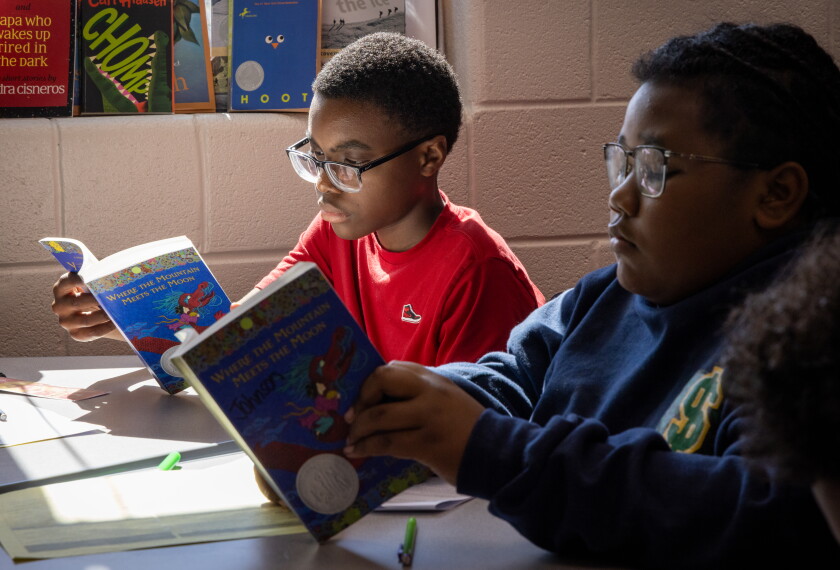
Students read Where the Mountain Meets the Moon in Jaime Johnson’s 6th grade language arts class at Murphy Middle School in Dacula, Georgia on September 22, 2026.
Students read <i>Where the Mountain Meets the Moon</i> in teacher Jaime Johnson’s 6th grade language arts class at Murphy Middle School in Dacula, Georgia on September 22, 2026. Johnson has students do most of the reading in class—to improve fluency, created a shared culture of engagement in books, and above all make sure every student completes the text.
Dustin Chambers for Education Week