College & Workforce Readiness

NCAA Moves to Bench Two Virtual Schools

By The Associated Press — June 07, 2010 2 min read
  • Save to favorites
  • Print

The National Collegiate Athletic Association has a message for would-be college athletes hoping to use online courses to bolster their high school transcripts: Proceed with caution.

The organization announced late last month that it will stop accepting course credit from two virtual schools, based in Utah and Illinois, as part of a move to strengthen high school eligibility standards in Division I.

That means no more high school credit from Brigham Young University’s independent-study program. The school in Provo, Utah, had previously been targeted by NCAA investigators and federal prosecutors pursuing claims of academic fraud involving the University of Missouri, University of Kansas, University of Mississippi, Nicholls State University in Louisiana, and Barton County Community College in Kansas.

Also on the association’s prohibited list is the American School, a correspondence program based in Lansing, Ill.

New NCAA rules require “regular access and interaction” between teachers and students in the 16 core courses that are required to establish initial eligibility for new college athletes.

Courses Need Rigor

The changes don’t affect Division II schools. An oversight panel from that division declined to endorse the proposed change but will consider the measure again this month.

“We want to make sure that student-athletes are qualified for college coursework,” said NCAA spokesman Chuck Wynne. “Students cannot teach themselves, and they cannot pace themselves. The courses need to have a certain amount of rigor.”

Such interaction doesn’t have to include face-to-face contact, according to the association. Telephone conversations, e-mail exchanges, and instant messages are also acceptable—provided the student receives specific comments and individual instruction.

The new rules don’t specify a minimum length for online courses. Instead, they require schools to “establish a defined period for completion of the course.”

The changes are effective Aug. 1. Students currently enrolled in the BYU and American School virtual programs can still petition the NCAA for course approval.

‘A Disappointment’

A BYU spokeswoman said the school’s independent-study program hopes to work with the association on potential improvements that could land it back on the list of approved online schools.

“We’ve always had a good relationship with the NCAA,” Carri Jenkins said. “We have worked very hard to make our courses as rigorous as any high school course.”

American School’s principal, Marie Limback, called the NCAA’s decision “shortsighted and a misunderstanding of the education we provide.”

“There’s no question about the rigor and level of education we provide,” she said of the 113-year-old school based in suburban Chicago. “It’s a disappointment for distance education.”

At the University of Missouri, the BYU program is best known as the school that provided former Tiger basketball player Ricky Clemons with nine of the 24 summer school credits he needed to enroll as a junior-college transfer in 2002.

While BYU said it found no evidence of cheating on Mr. Clemons’ part, questions about his enrollment and subsequent findings of more than 40 violations led to three years of NCAA probation under former Missouri basketball coach Quin Snyder.

The NCAA’s Mr. Wynne said that other virtual schools could be added to the decertification list.
A version of this article appeared in the June 09, 2010 edition of Education Week as NCAA Moves to Bench Two Virtual Schools

Events

Artificial Intelligence Webinar AI and 'Techlash' Are on a Collision Course. How Should Schools Respond?
Learn what strategies and tactics schools can develop to encourage smart and responsible AI use, while also enforcing tech guardrails.
This content is provided by our sponsor. It is not written by and does not necessarily reflect the views of Education Week's editorial staff.
Sponsor
Special Education Webinar
Special Education Disputes & Rising Costs: Protecting Your District
Special education costs and risks are rising. Learn how stronger IEP and Medicaid processes help districts protect funding and compliance.
Content provided by Relay
This content is provided by our sponsor. It is not written by and does not necessarily reflect the views of Education Week's editorial staff.
Sponsor
Personalized Learning Webinar
Differentiation That Delivers: Proven Practices From High-Growth Districts
Make every minute count. Proven strategies from educators and leaders driving real student growth. Save your seat!
Content provided by i-Ready, Curriculum Associates

EdWeek Top School Jobs

Teacher Jobs
Search over ten thousand teaching jobs nationwide — elementary, middle, high school and more.
View Jobs
Principal Jobs
Find hundreds of jobs for principals, assistant principals, and other school leadership roles.
View Jobs
Administrator Jobs
Over a thousand district-level jobs: superintendents, directors, more.
View Jobs
Support Staff Jobs
Search thousands of jobs, from paraprofessionals to counselors and more.
View Jobs

Read Next

College & Workforce Readiness Q&A Reading, Writing, and Math Skills Are Top Priorities in This CTE Program
How these teachers are connecting the dots between academic and technical skills.
4 min read
Cass Career Center
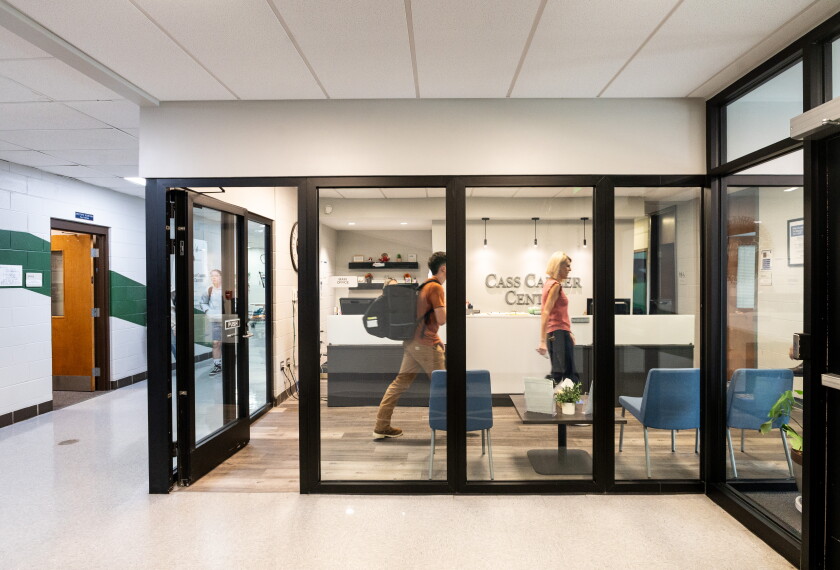
Assistant Director, Nicole Tews, walks a student through the administration office at the Cass Career Center in Harrisonville, Mo., on September 29, 2026. The center has a math and an English teacher who are integrated into students' industry-specific career programs.
Melissa Lukenbaugh for Education Week
College & Workforce Readiness Q&A Dual Enrollment Is Surging. Here's How High Schools Can Get it Right
More than 3 million high school students took a college course last year.
3 min read
Macomb Community College's South Campus in Warren, Mich. off of 12 Mile Road on Oct. 15, 2026.
Macomb Community College's South Campus in Warren, Mich., is shown on Oct. 15, 2026. In Michigan, 16 percent of community college students are high schoolers. Nationwide, dual enrollment now tops 3 million students.
Miles Oates/mlive.com via TNS
College & Workforce Readiness The CTE Program Answering the Question ‘Why Do I Need Math to Be a Firefighter?’
Integrating academic learning into career and technical education comes with challenges.
13 min read
Cass Career Center
Layton Heaper, a senior in the welding program at the Cass Career Center in Harrisonville, Mo., works on a project on Sept. 29, 2026. Through the school's integrated academics program, students learn and apply English and math skills related to future careers.
Melissa Lukenbaugh for Education Week
College & Workforce Readiness As Students Explore Alternatives to College, Are Counselors Ready to Help Them?
A new survey finds growing interest in non-degree pathways post-graduation, but schools are struggling to keep up.
3 min read
Kendall Gray (left) and Gala Davis (right), both guidance counselors, catch up and talk in Davisí office at South Oak Cliff High School in Dallas on March 6, 2025.
Kendall Gray, left, and Gala Davis, both school counselors, talk in Davis' office at South Oak Cliff High School in Dallas on March 6, 2025. A new survey polls school counselors about student career readiness.
Liz Rymarev/The Dallas Morning News via TNS