Special Report
Early Childhood

Paying Attention Earlier On

By Lynn Olson — December 29, 2006 2 min read
  • Save to favorites
  • Print

In his 2006 book Building Blocks: Making Children Successful in the Early Years of School, the author and education observer Gene I. Maeroff argues, “Unprecedented attention to schooling from preschool through 3rd grade offers greater promise for improving outcomes than almost any other step that educators might take.”

“Doing it right in the first place,” he explains, “is the most obvious way to give students what they will need to prosper in the classroom.”

Striking disparities in what children know and can do are evident well before they enter kindergarten. While the average 4-year-old in a family receiving welfare has heard some 13 million spoken words, for example, a child from a working-class family has heard about 26 million, and a child from a professional family almost 45 million, according to a study by Betty Hart and Todd R. Risley, summarized in their 1995 book Meaningful Differences.

Research has found that participation in intensive, high-quality early-childhood education can improve school readiness. Children who attend such programs are less likely to drop out of school, repeat grades, or need special education than children who have not had such experiences. As adults, they are less likely to commit crimes, more likely to be employed, and likely to have higher earnings.

Studies also suggest that poor and minority children stand to benefit the most academically from attending high-quality early-childhood programs.

Accompanying Charts

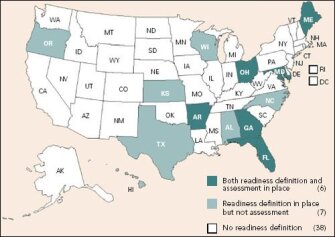
  • School Readiness Policymakers could help make the transition from preschool to elementary school smoother by specifying the knowledge and skills young children need to be ready for school. But to date, few states have both defined school readiness and required districts to assess the school readiness of entering students.
BRIC ARCHIVE

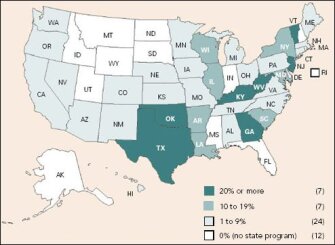
  • Preschool Enrollment Patterns Thirty-eight states now have state-financed preschool programs, enrolling some 10 percent of children, ages 3 and 4, according to the National Institute for Early Education, based at Rutgers University in New Brunswick, N.J. Only a handful of states have more than 20 percent of 3- and 4-year-olds attending state-financed preschools.
BRIC ARCHIVE

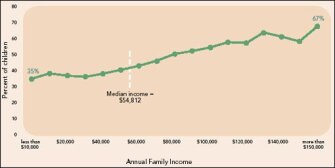
  • Preschool Split The likelihood that a child will attend preschool is strongly tied to family income. While research suggests that low-income children benefit most from high-quality early-childhood education programs, they are far less likely to attend center-based preschool of any kind than their more advantaged peers.
BRIC ARCHIVE

Access to such programs remains sharply divided by race and class, however. While 67 percent of 3- and 4-year-olds in families with annual incomes exceeding $150,000 attend preschool, that’s true for only 35 percent of children in families earning less than $10,000 a year, according to data from the U.S. Census Bureau.

States are increasingly recognizing the benefits of early-childhood education. According to the National Institute for Early Education based at Rutgers University in New Brunswick, N.J., 38 states now have state-financed preschool programs, enrolling some 10 percent of children ages 3 and 4. In total, 45percent of children ages 3 and 4 take part in some form of early-childhood education, according to the Census Bureau.

Policymakers could help make the transition from preschool to elementary education smoother by specifying the knowledge and skills young children need to be ready for school and by more closely aligning standards and curricula from preschool through the primary grades.

“Coordination should be the watchword of this effort,” writes Maeroff, “with standards, curriculum, instruction, and assessment aligned across the PK-3 continuum like the moving parts of a finely designed mechanical clock.”

Data Download

Early-Childhood EducationPDFExcel

According to a survey of the 50 states and the District of Columbia conducted for Quality Counts, 41 states and the District currently have early-learning standards aligned with state academic standards for the elementary grades. Thirteen states have defined what young children need to know and be able to do to be ready for school. Sixteen states require districts to assess the school readiness of entering students. And 18 states provide programs to help young children who do not meet school-readiness expectations.

Related Tags:

In March 2024, Education Week announced the end of the Quality Counts report after 25 years of serving as a comprehensive K-12 education scorecard. In response to new challenges and a shifting landscape, we are refocusing our efforts on research and analysis to better serve the K-12 community. For more information, please go here for the full context or learn more about the EdWeek Research Center.

Events

This content is provided by our sponsor. It is not written by and does not necessarily reflect the views of Education Week's editorial staff.
Sponsor
Recruitment & Retention Webinar
Hiring, Retention, and Fill Rates: A Data-Driven Sub Strategy
Explore what keeps substitutes coming back and hear how one district rebuilt its substitute hiring process and improved its fill rate.
Content provided by Frontline Education
Early Childhood K-12 Essentials Forum Early Childhood Education: Building Essential Skills for Success
Join this free virtual event to examine the biggest challenges in supporting young children, from preschool through elementary school. 
This content is provided by our sponsor. It is not written by and does not necessarily reflect the views of Education Week's editorial staff.
Sponsor
Student Absenteeism Webinar
Attendance Isn't an Attendance Problem
Boost attendance by strengthening relationships, belonging, and support with practical strategies from Doug Fisher & Nancy Frey.
Content provided by Corwin

EdWeek Top School Jobs

Teacher Jobs
Search over ten thousand teaching jobs nationwide — elementary, middle, high school and more.
View Jobs
Principal Jobs
Find hundreds of jobs for principals, assistant principals, and other school leadership roles.
View Jobs
Administrator Jobs
Over a thousand district-level jobs: superintendents, directors, more.
View Jobs
Support Staff Jobs
Search thousands of jobs, from paraprofessionals to counselors and more.
View Jobs

Read Next

Early Childhood Get in Line! Pre-K Expansion May Force 4-Year-Olds to Act Like Older Students
Experts explain why lines for little kids don't make sense, and offer alternatives.
3 min read
Pre-K students line up outside a classroom at the South Education Center, on April 2, 2014, in San Antonio.
Pre-K students line up outside a classroom at the South Education Center in San Antonio on April 2, 2014. Some experts have raised concerns about whether it's developmentally appropriate for preschoolers to stand and walk in lines.
Eric Gay/AP
Early Childhood Q&A If District Leaders Support Pre-K, Then Why Is It Not a Top Priority?
Superintendents can empower other leaders to nurture and grow their district's pre-K program.
6 min read
WASHINGTON,DC - JUNE 10: Dr. Aaron Spence, Superintendent, Loudoun County Public Schools and Dr. Macquline King, Superintendent and CEO of Chicago Public Schools speak during a House Education and Workforce Committee hearing titled “Breaking Trust: Attacks On Parental Rights, Inappropriate Content, And Legal Abuses In America’s Schools” on Capitol Hill on Wednesday, June 10, 2026 in Washington, DC.
Dr. Aaron Spence, Superintendent, Loudoun County Public Schools, and Dr. Macquline King, Superintendent and CEO of Chicago Public Schools, speak during a House Education and Workforce Committee hearing on Capitol Hill on June 10, 2026, in Washington, D.C. Superintendents believe pre-K is a priority for their districts, but it doesn't often translate to actively supporting early grades.
Jabin Botsford For Education Week
Early Childhood Q&A The Pre-K Push: Are Current Preschool Models Heading the Wrong Way?
Dale C. Farran has spent five decades studying early education, and shares her insights with EdWeek.
7 min read
In this Friday, March 13, 2020 photo, Pre-K students Nivayeh O'neal, 4, left, and Harper Lietchy, 5, go through the lunch line at Rivermont elementary school in Chattanooga, Tenn.
Pre-K students go through the lunch line at Rivermont Elementary School on March 13, 2020, in Chattanooga, Tenn. As a growing number of states plan to expand access to publicly funded pre-K, experts question its impact and direction.
Troy Stolt/Chattanooga Times Free Press via AP
Early Childhood Hey Diddle Diddle: What the Decline of Nursery Rhymes Means for Early Literacy
Nursery rhymes aren't just a quaint nod to the past: They're an engaging way to grow literacy skills.
5 min read
Nursery Rhymes, Disappearing, children's books, kids books, early childhood, early literacy
Illustration by Gina Tomko/Education Week + Canva