Science

Stuff It

By Emily Goodman — November 12, 2004 1 min read
  • Save to favorites
  • Print

Howard Whitten makes dead animals speak. It’s what a good taxidermist does—or a good science teacher, for that matter. And Whitten is both at Nokomis Regional High School in Newport, Maine, using taxidermy to identify the inner workings of animals for his biology students and showing his taxidermy class how to remove them.

“I wanted a chance to work with the dead animals,” says Mallory McAvoy, a senior in the taxidermy class, one of only a few such courses in the nation. “It’s definitely something I think everyone should get to experience; it’s different and unique.” The students in the taxidermy class and after-school club spend part of their days preparing the animals, learning about their habitats, and then reconstructing them.

Students in Howard Witten's classes learn all about animals.

Whitten’s taxidermy students aren’t the only ones who benefit from the specimens he’s scraped off the highway or begged from hunters and game wardens over the years. His biology classes get to learn about animals from their actual preserved bodies, not simply from two-dimensional slides and textbooks. And with the help of Whitten’s honors research students, who take their knowledge into the community, the animals get a much wider audience. “Everything we mount here goes out to schools, museums, and nursing homes,” he says. When they donate preserved specimens to elementary school classrooms, Whitten’s honors taxidermy students teach the kids about each animal and let them help mount it.

He now has a lot more subjects to work with. This fall, the Smithsonian Institution donated more than 400 rare animal carcasses from all over the world, including mountain lions, a grizzly bear, and a bighorn sheep. When all the preserving, stuffing, and mounting are done, Whitten hopes to create an animal library, which will lend specimens for museum display, school instruction, and other educational purposes. Eventually he’d like to create a dedicated museum where the entire collection could be displayed. But for now, Whitten says, he’s just looking to pique people’s interest through taxidermy and science. “That’s what we’re supposed to do in education—get kids excited.”

Events

This content is provided by our sponsor. It is not written by and does not necessarily reflect the views of Education Week's editorial staff.
Sponsor
Recruitment & Retention Webinar
Hiring, Retention, and Fill Rates: A Data-Driven Sub Strategy
Explore what keeps substitutes coming back and hear how one district rebuilt its substitute hiring process and improved its fill rate.
Content provided by Frontline Education
Early Childhood K-12 Essentials Forum Early Childhood Education: Building Essential Skills for Success
Join this free virtual event to examine the biggest challenges in supporting young children, from preschool through elementary school. 
This content is provided by our sponsor. It is not written by and does not necessarily reflect the views of Education Week's editorial staff.
Sponsor
Student Absenteeism Webinar
Attendance Isn't an Attendance Problem
Boost attendance by strengthening relationships, belonging, and support with practical strategies from Doug Fisher & Nancy Frey.
Content provided by Corwin

EdWeek Top School Jobs

Teacher Jobs
Search over ten thousand teaching jobs nationwide — elementary, middle, high school and more.
View Jobs
Principal Jobs
Find hundreds of jobs for principals, assistant principals, and other school leadership roles.
View Jobs
Administrator Jobs
Over a thousand district-level jobs: superintendents, directors, more.
View Jobs
Support Staff Jobs
Search thousands of jobs, from paraprofessionals to counselors and more.
View Jobs

Read Next

Science Opinion What Should Science Education Look Like 10 Years From Now?
Science instruction has already had some big changes in the past decade. Where is it going next?
8 min read
Conceptual illustration of classroom conversations and fragmented education elements coming together to form a cohesive picture of a book of classroom knowledge.
Sonia Pulido for Education Week
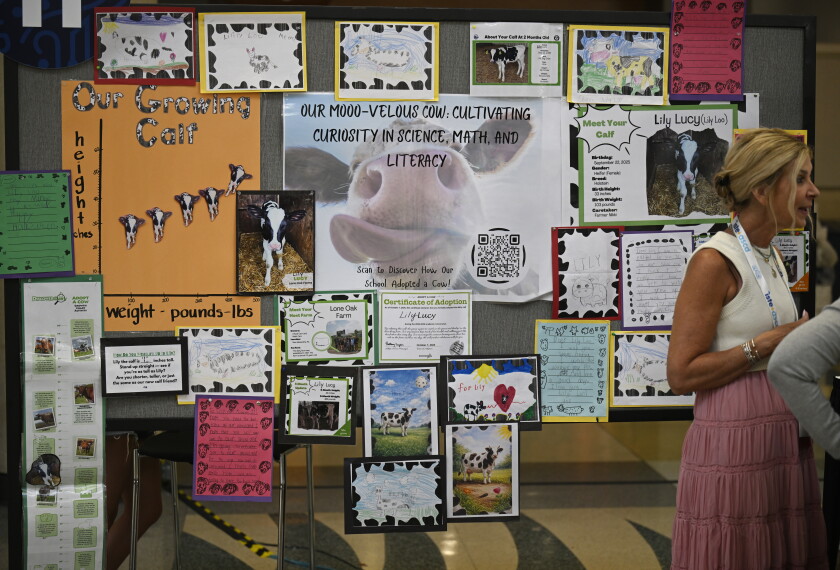
Science How a Cow 'Moooved' STEM and AI Learning Forward
The farm animal helped K-2 students explore artificial intelligence, data science, and chemistry.
3 min read
ISTEcow003
K-2 students at South Fayette Township Elementary School in Pennsylvania used data science to pick a name for a cow they adopted to follow at a local farm. A teacher from the school talked to other educators about how she used the cow to teach about data science, AI, and chemistry during the ISTELive 26 + ASCD Annual Conference in Orlando, Fla., on July 1, 2026.
Marvin Joseph/Education Week
Science Can a Science Museum Reshape Learning? Inside One District's Experiment
A state-of-the-art science museum and a formerly under-resourced elementary school form a rare partnership.
10 min read
DaVinciCentralAllentownPA 051826 SDL020
A 4th grade student vies for the attention of a turtle during her class’s weekly visit to the Da Vinci Science Center on May 18, 2026, as part of the center’s partnership with the Allentown school district’s Central Elementary STREAM Academy.
Scott Lewis for Education Week
Science Spotlight Spotlight on STEM That Sticks: How Schools Spark Curiosity and Build Future Skills
Find out how schools are cultivating enthusiasm for STEM learning through family STEM nights, low-cost innovations, and more!
