

U.S competitiveness in the technology industry—in artificial intelligence, specifically—has been a major focus of the Trump administration.
President Donald Trump signed an executive order last year instructing federal agencies to take steps to teach students how to use AI, train teachers to incorporate it into their work, and partner with the private sector to develop relevant programs in schools.
Still, individual teachers’ use of AI and modes of experimentation with the fast-changing technology vary widely, based on how much training and guidance they’ve received.
Join us at ISTE+ASCD
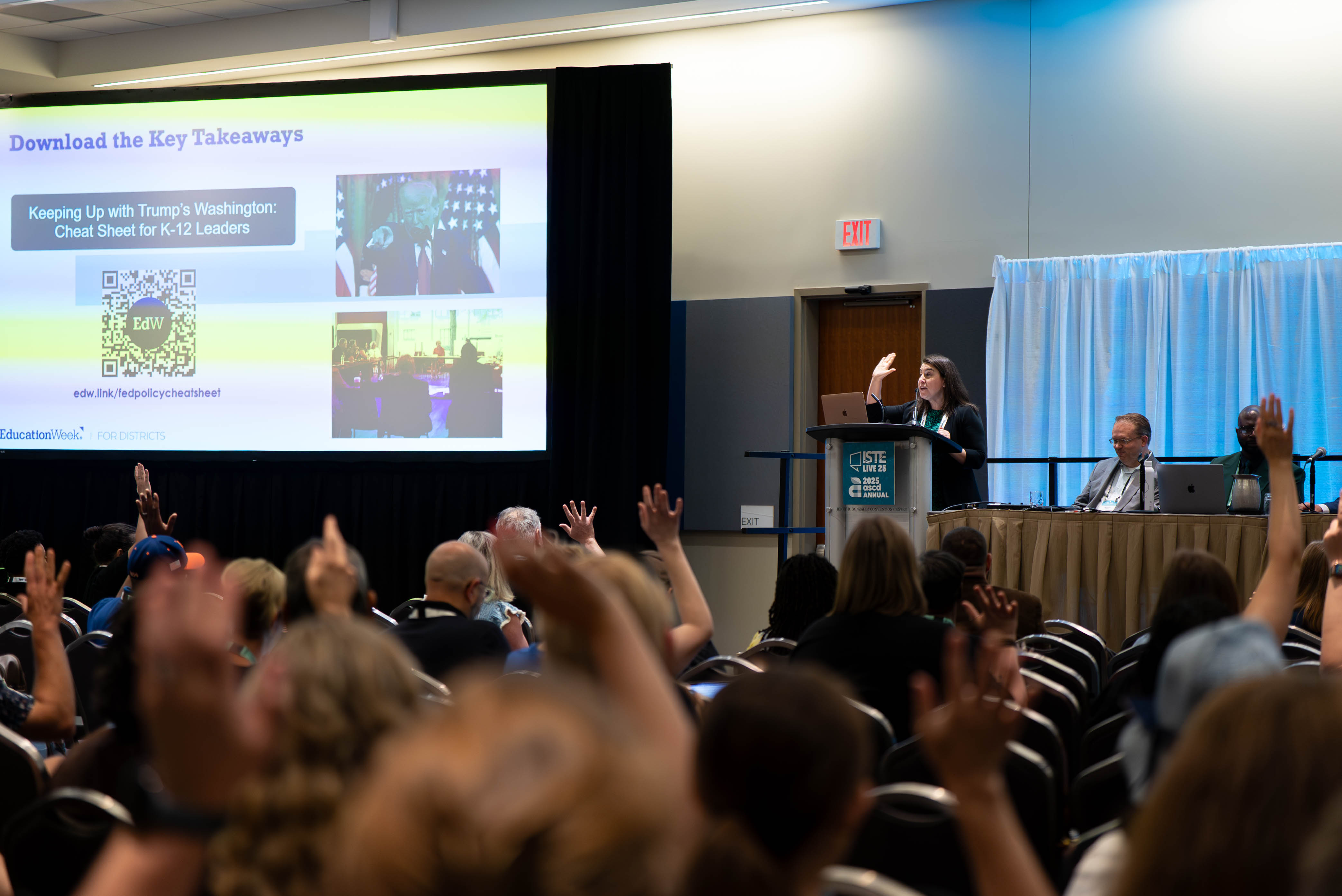
Heading to Orlando for the ISTE/ASCD conference? Be sure to attend The Ed-Tech Backlash Is Here. How Should District Leaders Respond? on Monday, June 29, 1-2 pm ET. Join EdWeek Assistant Editor Alyson Klein, EdWeek Research Center Director Holly Kurtz, and a panel of district leaders to understand what’s fueling the ed-tech pushback, get practical takeaways on how to respond to community concerns about screen time, and more.
Join us >For the past year, two Albert Einstein Distinguished Educator Fellows have used their classroom knowledge and experiences to help inform national education efforts, with a focus on AI and workforce development.
Shane Wines, a computer science teacher in Maryland, and Kyle Kuhlers, a cybersecurity teacher in Iowa, are scheduled to present a session on integrating AI and computer science across curricular areas at the ISTELive 26 + ASCD Annual Conference, which is being held in Orlando, Fla., between June 28 to July 1.
Education Week interviewed Wines and Kuhlers ahead of the conference to discuss what they’ve learned from their fellowship.
This interview has been edited for length and clarity.
What are you focusing on during your fellowship?
Wines: I was placed with the Navy, at Carderock, in Bethesda, Md. A big part of what I’ve been doing is building new computer science and AI curricula. If you’re familiar with Hour of Code/Hour of AI, I built one of the games this year. It’s called Drone Command Operation Uplink. Kids are learning about unmanned underwater vehicles. They’re learning a little bit about drone history, Carderock, and what different naval professions are out there.
One thing I found this year is a lot of people don’t know that there are so many ways to be an engineer, a scientist, an accountant, a lawyer, and help support the Navy.
I also built a lot of curriculum around robotics. The Navy has one of the Boston Dynamics robots, so I’ve got to do some coding with that, some AI. I’ve brought it to a bunch of schools, just inspiring young minds to want to work in STEM fields.

Kuhlers: I’m in the House Education and Workforce Committee for the majority. The committee has an interest in AI, and the committee has been doing a series of AI hearings, one of which I was able to be extremely active in and help put together, interviewing the witnesses, selecting witnesses, and then sitting in during the hearing.
Some of the committee went to California, visited some of the big tech companies to have a discussion directly with them around AI, and the message that we came away with is: In order for people to be comfortable with AI, you have to use it.
One of the main things, too, that we hear from the workforce over and over again is: For students to be employable, they have to have experience with AI. They have to know the power of AI and how AI can augment and make their work more efficient in the workforce.
What are the biggest challenges you’ve heard from educators around using AI in their work?
Kuhlers: Some of the biggest challenges that we’re hearing are around professional development. Getting educators to the point where they’re comfortable may take too long. Getting educators to a confidence level with their skill set so they’ll be able to navigate it and figure it out along with the students is a mindset shift.
There’s new models being released every month that are being updated, and the pace of this technology moves a lot faster than education does. Does the baseline skill include being OK with the changes? How do you stay in tune with what’s going on? How do you find answers and research?
Wines: A lot of teachers are frustrated with the constant blocking and unblocking of different AI tools. They’ll take time to invest in one tool, and then next week it’s blocked, because there was some bad experience with another educator or student, or some regulation coming from the state or the school district’s board of education is changing.
It’s hard for them to want to buy into the technology when they know that it may be blocked or unblocked at any moment, or some of the features may be limited, or they’ll do it at home and then it’s blocked on the school district, or they have access to it, but the students don’t have access to it.
What role could the federal government play in addressing these challenges?
Wines: Based on my fellowship experience, I think the federal government can play an important role in creating clearer guidance and shared expectations around how AI tools can be used safely and responsibly in schools.
Federal agencies could help by supporting model policies, educator training, and vetted resources that give schools confidence to unblock tools while still protecting privacy, security, and equity. I also think the government can help bridge classroom practice with workforce needs by investing in AI literacy experiences that prepare students to use these tools thoughtfully, not just avoid them.

Kuhlers: For educators to get the full idea of AI’s power, I believe they need to be given time to develop their skills in AI by using it. One of the best plans I have seen had three steps: Develop a district policy, expectations and list of appropriate tools; provide staff professional development around those tools with the time to experiment and try classroom ideas; and roll out the tools with students. The federal government can encourage current funding to include technology training as an appropriate use for AI professional development.



