

Ed-Tech Policy

FCC Update to E-Rate Program Will Help Students Do Homework Anywhere

By Lauraine Langreo — July 18, 2024 3 min read
Photo of a blurred image of a female student in the background working on a laptop at home with a closeup of the modem router on the table in the forefront.
  • Save to favorites
  • Print

It will now be easier for schools to cover the cost of providing Wi-Fi hotspots to students who don’t have adequate access to internet and broadband services at home.

Under a change approved July 18 by the Federal Communications Commission, schools will now be allowed to use federal E-rate funding to pay for Wi-Fi hotspots.

FCC Chair Jessica Rosenworcel, a Democrat, supported the measure along with the two other Democrats on the five-person commission. Both Republicans on the panel voted against it.

Rosenworcel, during the meeting, recounted the early days of the pandemic when students had to sit outside of fast-food restaurants or libraries or school buildings with their laptops on their knees, using the free Wi-Fi because they lacked home connectivity.

Congress authorized a couple temporary programs to address the need: the Emergency Connectivity Fund and the Affordable Connectivity Program, but both have expired.

The Democratic commissioners said there are still millions of students who don’t have adequate access to the internet and modernizing the E-rate program ensures that students can do their schoolwork wherever they are.

“Today, we have a choice,” Rosenworcel said. “We can go back to those days when people sat in parking lots to get a signal to get online and students struggling with the ‘homework gap’ hung around fast-food places just to get the internet access they needed to do their schoolwork. Or we can go forward and build a digital future that works for everyone.”

See Also

Student at computer from home, doing school work with  wifi connection icon images overlaying image.
Liz Yap/Education Week and E+/Getty.
Ed-Tech Policy Q&A How the FCC Wants to Tackle the 'Homework Gap'
Lauraine Langreo, July 15, 2024
4 min read

The Republican commissioners, however, argued that the change goes beyond the FCC’s authority.

“Congress limited the FCC E-rate authority to enhancing the access of—Congress’s specific terms—classrooms and libraries to telecom services, not any remote location at which people might want to learn,” said Republican Commissioner Brendan Carr.

Commissioner Nathan Simington, another Republican, also argued that off-campus Wi-Fi hotspots could “reduce incentives to physically show up to a classroom” and seemed to doubt that the hotspots would actually be used for learning at home.

Still, Rosenworcel said the FCC has the authority to “update the definition of universal service, which includes E-rate, so that it evolves over time.” Congress also gave the FCC authority to “designate additional services in this program as needed for schools and libraries,” she added.

Schools that use E-rate funding have to comply with the Children’s Internet Protection Act, which requires them to use filters to ensure children are protected from exposure to harmful material while accessing the school-provided internet.

See Also

School kids looking at a girl's mobile phone across the aisle of a school bus.
iStock/Getty

Several K-12 education groups—such as AASA, the School Superintendents Association, the Consortium for School Networking, the Association of School Business Officials International, and the National Rural Education Association—have praised this expansion of how E-rate funds can be used.

“Today’s vote allows the E-rate program to continue its important work in ensuring our nation’s schools and libraries are able to offer our 24-hour learners 24-7 access to broadband,” said David R. Schuler, the executive director of AASA, in a written statement.

Funds for Learning CEO John Harrington called it a “forward-thinking approach” and aligns with “the realities of today’s educational landscape.” Funds For Learning works with schools to help them determine how best to apply for and use E-rate funds.

The recent change to the E-rate to pay for Wi-Fi hotspots is part of Rosenworcel’s broader push to modernize the program and provide technology services she thinks schools need. The E-rate, established in 1996, has helped schools and libraries connect to the internet at discounted rates but hasn’t been used to help students get internet connectivity at home.

Among the other recent changes to the program, which have already been approved, are the expansion of E-rate funding to pay for school bus Wi-Fi and the creation of a cybersecurity pilot program for K-12 schools.

The school bus Wi-Fi initiative has run into legal opposition, however. A lawsuit, filed in December and pending in the 5th U.S. Circuit Court of Appeals, argues that using E-rate funds for Wi-Fi on school buses exceeds the FCC’s authority to provide internet access in schools and libraries. The FCC has filed a motion to dismiss the case.

Events

This content is provided by our sponsor. It is not written by and does not necessarily reflect the views of Education Week's editorial staff.
Sponsor
Student Absenteeism Webinar
Attendance Isn't an Attendance Problem
Boost attendance by strengthening relationships, belonging, and support with practical strategies from Doug Fisher & Nancy Frey.
Content provided by Corwin
This content is provided by our sponsor. It is not written by and does not necessarily reflect the views of Education Week's editorial staff.
Sponsor
Classroom Technology Webinar
Screen Time and AI: An Evidence Playbook for School Leaders
Get a clearer picture of the current policy landscape, a framework for evaluating new tools, plus language to use in the next board meeting.
Content provided by Instructure
This content is provided by our sponsor. It is not written by and does not necessarily reflect the views of Education Week's editorial staff.
Sponsor
School & District Management Webinar
The Principal's Role in Collective Efficacy and Student Outcomes
Learn practical strategies that help principals translate their confidence into stronger collective teacher efficacy and student outcomes.
Content provided by Otus

EdWeek Top School Jobs

Teacher Jobs
Search over ten thousand teaching jobs nationwide — elementary, middle, high school and more.
View Jobs
Principal Jobs
Find hundreds of jobs for principals, assistant principals, and other school leadership roles.
View Jobs
Administrator Jobs
Over a thousand district-level jobs: superintendents, directors, more.
View Jobs
Support Staff Jobs
Search thousands of jobs, from paraprofessionals to counselors and more.
View Jobs

Read Next

Ed-Tech Policy ‘Essential Infrastructure’: Education Groups Raise Concerns About FCC's E-Rate Review
The FCC might limit or end the program that subsidizes broadband connectivity for schools.
4 min read
Fifth and second grade students work together using Magic School AI to build presentations during class at Galileo STEM Academy in Eagle, Tuesday, Feb. 24, 2026.
Fifth and 2nd grade students work together using Magic School AI to build presentations during class at Galileo STEM Academy in Eagle, Idaho, on Feb. 24, 2026. Education groups are raising concerns that the FCC's review of a program that helps fund school internet connectivity could lead its demise.
Sarah A. Miller/Idaho Statesman via TNS
Ed-Tech Policy RFK Jr. Calls for Children to Have 'Less Screen Time and More Real Life'
Speakers at an event hosted by the Department of Health and Human Services discuss the harms of student screen time, and possible solutions.
4 min read
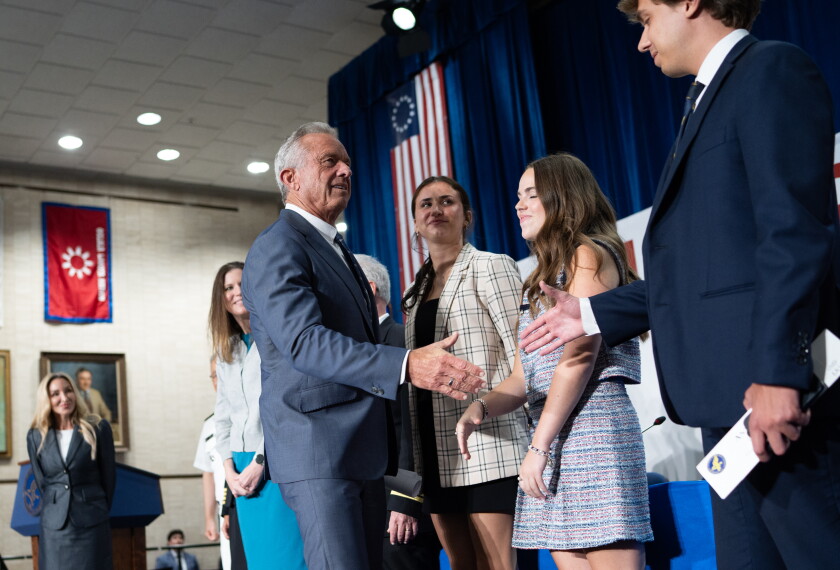
Robert F. Kennedy Jr., Secretary of Health and Human Services, shakes hands with the organizers of the event at the Hubert Humphrey Building in Washington on Sept. 1, 2026.
Robert F. Kennedy Jr., Secretary of Health and Human Services, shakes hands with the organizers of an event focused on the harms of student screen time at the Hubert Humphrey Building in Washington on Sept. 1, 2026. The symposium is part of HHS’s Live Real Life campaign, a national effort aimed at helping families, schools, and communities reduce harmful screen use and create more opportunities for children to engage in real-world experiences.
Sarah L. Voisin For Education Week
Ed-Tech Policy Opinion Is the Backlash Against Tech in Schools Going Too Far?
As schools rethink their relationship with tech, there are questions they should be asking.
Lina Eroh
5 min read
Photo illustration of an elementary-aged Caucasian boy with outstretched legs and a laptop on his lap. He is sitting on a very large cellphone propped up by four orange construction cones. The background is a montage of overlapping rectangle shapes with some ghosted images of young elementary students using a variety of tech (headphones and cellphones).
Photo illustration by Gina Tomko/Education Week + Canva
Ed-Tech Policy FCC Launches Review of E-Rate Program Amid Screen Time Debate
The end of the E-rate program would be an "existential threat" for schools, advocates say.
4 min read
Debbie Castlen, a bus monitor for Daviess County Public Schools, sits in front of a parked school bus outfitted with wifi in the parking lot at Russell Shifley Park, Wednesday, Aug. 26, 2020, in Owensboro, Ky. Castlen was working a 4-hour shift at the bus, which enables students without wifi at home to download their school assignments as the new school year begins with students working remotely.
Debbie Castlen, a bus monitor for the Daviess County public schools, sits outside a school bus equipped with Wi-Fi at Russell Shifley Park in Owensboro, Ky., on Aug. 26, 2020, where she worked a shift helping students without home internet download assignments as the school year began remotely. The setup reflects the kind of connectivity effort now under scrutiny as federal officials review the future scope of the E-rate program.
Greg Eans/The Messenger-Inquirer via AP
