Artificial Intelligence Q&A

How to Use Paper to Teach About AI and Cutting-Edge Tech

By Arianna Prothero — June 30, 2026 3 min read
ISTEJune29A
  • Save to favorites
  • Print

Students don’t have to use an artificial intelligence program to learn about AI.

There’s an alternate approach—“unplugged AI” —which leverages paper and other analog tools to teach about the cutting edge technology. It was the subject of a session at the ISTELive 26 + ASCD Annual Conference, held here this week.

Although unplugged AI may sound like a contradiction in terms, Roberta Freitas, an education technology specialist and Google Trainer, says that these activities can teach students critical concepts about AI bias, data classification, and algorithms.

“Unplugged activities are about what is behind AI, the concepts, the fundamentals, without using technology,” she said.

These teaching strategies don’t have to be completely unplugged from technology. There are many other digital tools educators can use to show students the mechanics of how AI works.

Freitas presented on the concept this week’s ISTE event. She spoke with Education Week about how unplugged AI activities can provide students with a strong foundational understanding of how AI works before they ever type a query into a chatbot.

One of her messages to educators: Students aren’t the only ones who can benefit from unplugged activities.

This conversation has been edited for length and clarity.

Roberta Freitas, owner of RF Education Innovation and Technology gives a presentation where artificial intelligence can guess the drawings a person makes during ISTELive 26 + ASCD Annual Conference at the Orange County Convention Center in Orlando, Florida on June 29, 2026

What are the benefits of teaching AI, unplugged from technology?

I have a 20-hour course for teachers and [in] the first 15 hours of the course, we don’t touch AI, we don’t use AI. We just talk about it. And when teachers actually get to use AI, they are much more critical because they understand what’s behind [it]. They understand why they’re getting those answers.

I’m Brazilian. And for us, there’s lots of bias in AI. Whenever we ask for an image or text, what we get are very American pictures. If you ask for an image of a teacher, you are going to get a teacher inside an American [classroom]. If you ask it to be Brazilian, they’re going to put a Brazilian jersey or a Brazilian flag in the room.

So, it’s very important for students and teachers to understand what’s behind [AI], why they get the answers they’re getting. This is why it’s very important to get the fundamentals before you actually interact with AI.

What ages are these activities best for?

It could be used in all grades, [but] especially for very young kids because there are age restrictions with AI. So, for very young students, they need to be ready for this world because AI is infused in everything. We need to understand how this works. Why do you get the recommendations you’re getting on social media?

With older students, when you’re introducing a concept, I think it’s important to know what that means before they get to interact with technology.

What is an example of an unplugged AI activity?

Bias detectives. This is an activity to get students to understand that bias is not generated or invented by AI. Bias is in society. Bias is in the data that is being used to train AI.

So, [students] get a set of [cards with] doctors, surgeons, and nurses, they’re either male or female. And the students will have to analyze how many doctors are male [or] female.

The bias here [in the cards] is nurses are mostly female. Surgeons are mostly male, doctors are mostly male. So this is for students to understand [that AI generalizations are] not coming out of nowhere, [they’re] not being invented.

Roberta Freitas, owner of RF Education Innovation and Technology gives a presentation where artificial intelligence can guess the drawings a person makes during ISTELive 26 + ASCD Annual Conference at the Orange County Convention Center in Orlando, Florida on June 29, 2026.

So, students see that the AI output can be skewed. Do manipulatives help crystallize what’s happening under the hood?

When it’s more visual and you get to really manipulate and interact, it gets you to think deeper and talk to other students. I usually do these in groups.

So students have to interact and collaborate to come to an answer. And I believe that using their hands makes things more tangible and more memorable for students.

Related Tags:

Events

This content is provided by our sponsor. It is not written by and does not necessarily reflect the views of Education Week's editorial staff.
Sponsor
School Climate & Safety Webinar
There But Not Present: Rethinking Student Engagement
Learn how to recognize the early signs of disengagement and what the behavioral science reveals about which interventions actually work.
Content provided by Frontline Education
Teacher Preparation Webinar What Teacher Education Should Look Like in the Age of AI
Explore the current trends around the use of AI in teacher preparation and continuing education with data from the EdWeek Research Center.
English Learners Webinar How Can School Districts Better Support English Learners With Disabilities?
Join this webinar to hear recent findings from the EdWeek Research Center and discover practical strategies for improvement.

EdWeek Top School Jobs

Teacher Jobs
Search over ten thousand teaching jobs nationwide — elementary, middle, high school and more.
View Jobs
Principal Jobs
Find hundreds of jobs for principals, assistant principals, and other school leadership roles.
View Jobs
Administrator Jobs
Over a thousand district-level jobs: superintendents, directors, more.
View Jobs
Support Staff Jobs
Search thousands of jobs, from paraprofessionals to counselors and more.
View Jobs

Read Next

Artificial Intelligence A Reckoning on Social Media Addiction Came Late for Kids. Will AI Safety Be Different?
Efforts to make social media safer offer lessons for those looking to protect children using AI.
5 min read
Kristin Bride, right, mother of 16-year-old Carson Bride, who died by suicide after being cyber-bullied on an anonymous app on Snapchat, is joined by Amy Neville, left, mother of 14-year-old Alexander Neville, who died from fentanyl poisoning after being deceived by a drug dealer operating on Snapchat, during a Social Media Victims Remembrance Day memorial on Capitol Hill, June 23, 2026, in Washington.
Rod Lamkey, Jr./AP
Artificial Intelligence Opinion Think Your Students Know More About AI Than You Do? Read This
Here are four things your students don’t understand about AI—and what you can do about it.
Sam Wineburg & Nadav Ziv
•
4 min read
102026 opinion Wineburg AI media literacy
Vanessa Solis/Education Week + Getty
Artificial Intelligence ChatGPT's 'Teen Mode' Is Unsafe for Students, Report Concludes
The chatbot failed to report unsafe interactions to parents in a timely manner, researchers found.
5 min read
Young man using a smartphone to ask an AI about exercise
Vanessa Solis/Education Week + Getty
Artificial Intelligence At OpenAI Forum, Discussion Focuses on Stronger Teen Safety Measures
Panelists put forward ideas on how to incentivize industry to develop responsible products.
4 min read
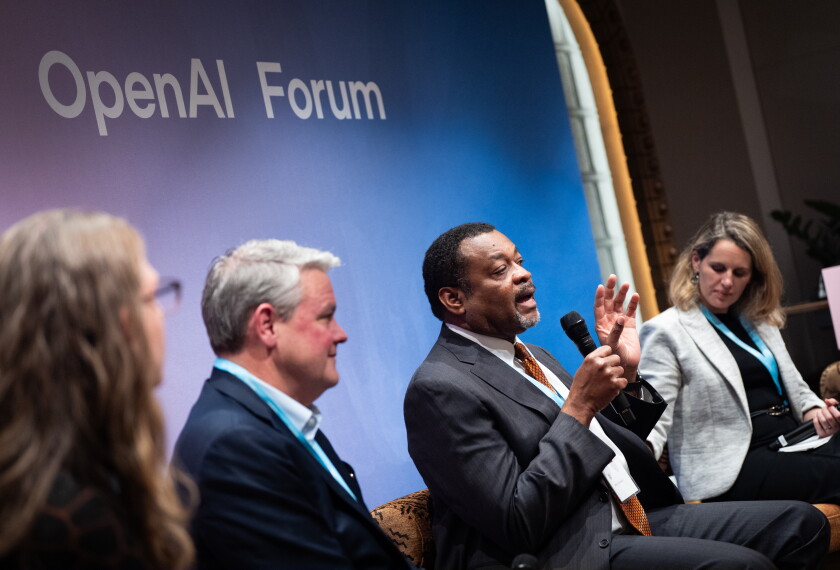
Washington, DC - October 5, 2026: Arthur C. Evans Jr., PhD, Chief Executive Officer of the American Psychological Association  speaks during the discussion. The OpenAI Forum hosted a panel on Responsible AI for Teens, how AI can support teens’ learning while promoting safe, healthy use. The program featured an OpenAI Forum panel with experts in learning, adolescent mental health, and family and online safety: Kate Ruane, Director of the Free Expression Project at the Center for Democracy & Technology, Chuck Melley, SVP of Policy, Advocacy and Communities at CodeAI, Arthur C. Evans Jr., PhD, Chief Executive Officer of the American Psychological Association and Mathilde Cerioli, Chief Scientist at everyoneAI. Chris Lehane, OpenAI’s Chief Global Affairs Officer, moderated the conversation and shared context on ChatGPT for Teens, a learning-first experience launched in August and designed to help teens think critically, deepen understanding, and use AI with confidence.
Arthur C. Evans, Jr., the CEO of the American Psychological Association, speaks on a panel at an Oct. 5, 2026, OpenAI forum on how to support responsible use of AI among teenagers.
Sarah Voisin for Education Week