Artificial Intelligence

Meet ‘Stretch,’ a New Chatbot Just for Schools

By Alyson Klein — June 26, 2023 2 min read
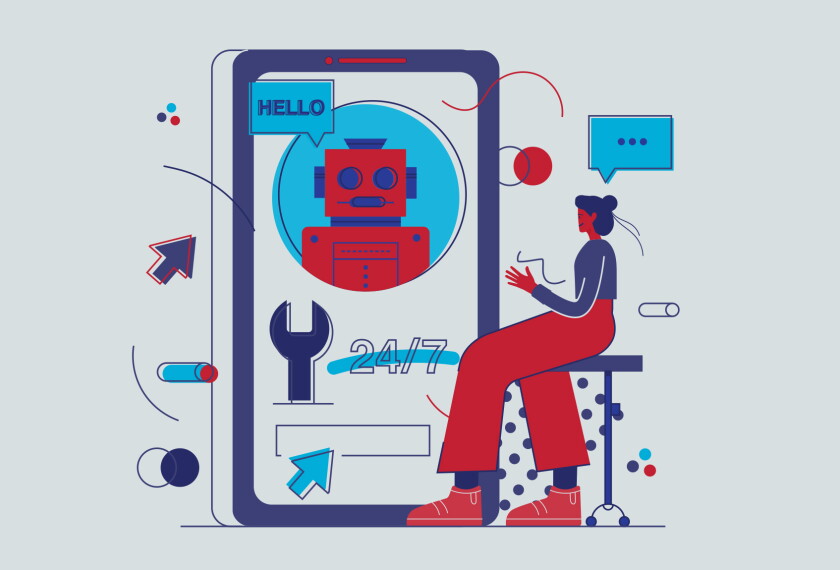
Illustration of woman using AI on phone.
  • Save to favorites
  • Print

Get ready for “Stretch,” a chatbot being designed specifically for K-12 educators.

The chatbot is the brainchild of the newly combined professional development mega organization created by the merger of the International Society for Technology in Education and ASCD.

The nonprofit organization has worked with Google and Open AI (the team behind ChatGPT) to create its very own chatbot, informed by the same kind of large language models that power ChatGPT, persona bots, and other artificial intelligence tools. The Stretch prototype is currently being tested by a select group of people and is not yet available for public use.

See Also

Photo collage of computer with pixelated image of girl.
F. Sheehan for Education Week / Getty

But Stretch will have one very different feature than most other chatbots. Instead of absorbing information from the entire internet to train its artificially intelligent brain, Stretch is only learning on materials that have been developed or vetted by ISTE and ASCD. Eventually, the tool may include information from other education and tech organizations that ISTE partners with.

If Stretch is asked a question about, say, approaches to social-and-emotional learning, it will only be able to draw on research, articles, and other information that has already been examined by ISTE and any other participating organizations.

That will enable Stretch to avoid the pitfalls of ChatGPT and similar chatbots, which often spit out inaccurate or outdated information, said Richard Culatta, ISTE’s CEO, during a roundtable discussion and demonstration with reporters here. (For instance, a chatbot mimicking President Barack Obama inaccurately parroted his administration’s critics as his own views when talking to a reporter about the president’s record on K-12 education).

What’s more, unlike other large language models, Stretch cites its sources, giving it another layer of accountability, Culatta said. And if it’s asked about something outside of its areas of expertise, it will tell users it can’t help with the question, instead of making something up, a characteristic of most chatbots that pull information from the entire internet.

A key goal of Stretch: “In terms of the reliability of information, it’s rock solid,” said Joseph South, the chief innovation officer at ISTE.

ISTE is still developing Stretch and hopes to give a wider group of educators a chance to use the tool soon. Eventually, Stretch may be used to help educators with research and professional development.

Stretch is one of the first so-called “walled garden AI” tools trained on a limited, carefully curated pool of information to serve a specific community, in education or any area, Culatta said.

“I do think you will see this rolling out in other sectors, but I think we’re among the first to do it,” Culatta said. “I hope this is a cool tool. But the real value is to say, hey, the future of AI, especially in learning, is to create these specialized tools where we can control exactly what the content is.”

A version of this article appeared in the July 12, 2023 edition of Education Week as Meet ‘Stretch,’ a New Chatbot Just for Schools

Events

This content is provided by our sponsor. It is not written by and does not necessarily reflect the views of Education Week's editorial staff.
Sponsor
Recruitment & Retention Webinar
Hiring, Retention, and Fill Rates: A Data-Driven Sub Strategy
Explore what keeps substitutes coming back and hear how one district rebuilt its substitute hiring process and improved its fill rate.
Content provided by Frontline Education
Early Childhood K-12 Essentials Forum Early Childhood Education: Building Essential Skills for Success
Join this free virtual event to examine the biggest challenges in supporting young children, from preschool through elementary school. 
This content is provided by our sponsor. It is not written by and does not necessarily reflect the views of Education Week's editorial staff.
Sponsor
Student Absenteeism Webinar
Attendance Isn't an Attendance Problem
Boost attendance by strengthening relationships, belonging, and support with practical strategies from Doug Fisher & Nancy Frey.
Content provided by Corwin

EdWeek Top School Jobs

Teacher Jobs
Search over ten thousand teaching jobs nationwide — elementary, middle, high school and more.
View Jobs
Principal Jobs
Find hundreds of jobs for principals, assistant principals, and other school leadership roles.
View Jobs
Administrator Jobs
Over a thousand district-level jobs: superintendents, directors, more.
View Jobs
Support Staff Jobs
Search thousands of jobs, from paraprofessionals to counselors and more.
View Jobs

Read Next

Artificial Intelligence LAUSD Adopts Moratorium on Student AI Use, Another Move to Limit Classroom Tech
The nation's second-largest district is pausing student use of generative artificial intelligence.
Howard Blume, Los Angeles Times
3 min read
A student uses Ed, a new district-developed Artificial Intelligence-assisted "learning acceleration web-based platform that will boost student success and revolutionize how K-12 education is tailored to meet individual needs," during the official launch event at Edward R. Roybal Learning Center in Los Angeles on March 20, 2024 .
A student uses Ed, the Los Angeles Unified School District's custom AI platform that later failed, during a launch event at Edward R. Roybal Learning Center in Los Angeles on March 20, 2024. LAUSD has now adopted a moratorium on student AI use. New York City schools have banned AI-powered tools for elementary and middle school students, meaning the nation's two largest districts have adopted major restrictions on student AI use.
Christina House/Los Angeles Times/TNS
Artificial Intelligence New York, Los Angeles Restrict Student AI Use. Will Other Districts Follow?
The restrictions come amid rising concerns about overreliance on technology in schools.
7 min read
Mayor Zohran Kwame Mamdani and Schools Chancellor Kamar H. Samuels today announced a moratorium on student-facing generative Artificial Intelligence (AI) use in schools, alongside a new screen time policy, a decision that will impact nearly 600,000 public school students, or two-thirds of the system's total enrollment at The Brooklyn Steam Center in New York City on Sept. 2, 2026.
Mayor Zohran Kwame Mamdani and Schools Chancellor Kamar H. Samuels announced a moratorium on student-facing generative artificial intelligence use in schools and a new screen-time policy during a press conference at The Brooklyn Steam Center in New York City on Sept. 2, 2026. The moratorium is part of a growing nationwide movement to ban or limit the use of AI and decrease screen time in schools.
Katie Godowski/MediaPunch /IPX via AP
Artificial Intelligence Spotlight Spotlight on Using AI with Purpose: Building Responsible Practices for Schools
Learn how to implement AI responsibly with practical guidance for school leaders, teachers, and district decisionmakers.
Artificial Intelligence Schools Caught Flat-Footed After Google Makes Gemini Chatbot Available to All Students
Schools wrestle with the question of whether to permit or prohibit access to the AI chatbot.
5 min read
Social Studies teacher Simon Sharick supervises students at the Plymouth High School in Ohio on how to properly prompt the Gemini Ai App to get their desired information. Students were using the Gemini App for the first time on Friday, Aug. 28, 2026.
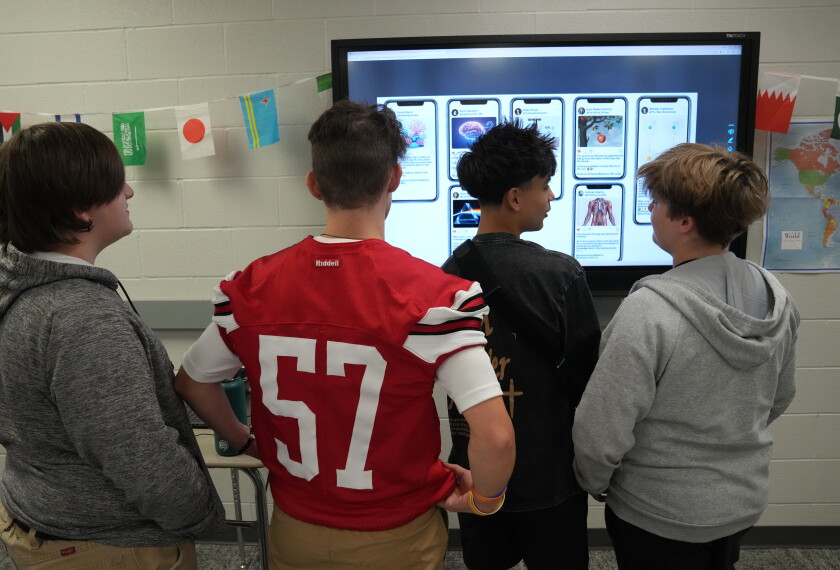
Students in a social studies class on Aug. 28, 2026, at Plymouth High School in Plymouth, Ohio, learn how to properly prompt Google's Gemini chatbot to generate useful and accurate information. In August, Google made Gemini available to K-12 students of all ages. <br/>
Ruddy Roye for Education Week