Classroom Technology

Newer Educators Are Less Likely to Say Tech Helps Students Learn

By Alyson Klein — October 28, 2026 2 min read
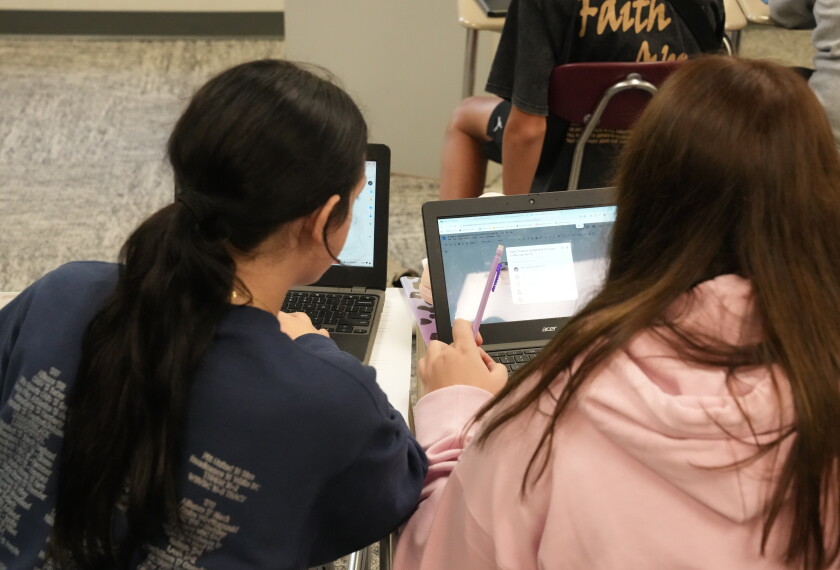
Katrina Sacurom, a teacher at Shawnee Trail Elementary School, in Frisco, Texas, works with her educator peers on Feb. 11, 2026. Sacurom has personalized her school's AI tool to mimic her writing style. A survey conducted by the EdWeek Research Center finds that educators who are relatively new to the profession are more skeptical that tech can positively influence learning than are veterans in the profession.
  • Save to favorites
  • Print

Being a so-called digital native doesn’t necessarily make educators more enthusiastic about education technology.

In fact, educators with fewer than 10 years of experience are less likely to say that technology increases learning than those with a decade or more in the profession, according to an EdWeek Research Center survey of 596 educators conducted in February and March.

About 1 in 6 educators with less than 10 years’ experience—17%—said that technology does more to increase than decrease learning.

By contrast, nearly 2 in 5 teachers with 10 to 14 years’ experience—39%—see tech as a net plus for learning.

The data suggest that earlier-career educators are more open to the idea that tech has the potential to be both a positive and a negative, however.

Almost half of educators with less than 10 years of experience say that technology is equally likely to increase or decrease learning. That’s higher than those with more time in the profession.

The debate over whether digital tools help or hinder learning isn’t new. But the survey findings come as school districts and states are moving to limit students’ technology use, amid rising concerns that screen time is damaging to students’ mental health.

EdWeek explored young teachers’ complicated views of technology in this year’s State of Teaching report. Gen Z teachers entered the profession just as smartphones were become ubiquitous, but some educators in that age group say their experiences have led them to set boundaries on their own use of tech, and encourage their students to limit their tech immersion.

To younger teachers, technology is not “cool or fresh or new,” said Cory Montreuil, an instructional coach in Denver who has worked in K-12 education for 14 years. “[It’s] the thing [they] do Snapchat with.”

But for Montreuil, who grew up playing video games now considered old-school, it feels “really cool” to assign students to build a website as a capstone project.

One educator’s views of tech jaundiced by the pandemic

On the other hand, Tyler Hunt, a middle school teacher in suburban Chicago, now in her eighth year of teaching, had to deal with the pandemic—and a sudden pivot to virtual learning—near the beginning of her teaching career.

“It was the worst experience,” Hunt said, and may have influenced her views of education technology.

What’s more, Hunt, 30, is part of a generation that spent their teen years in a tech “haze,” to the detriment of their mental health, she said. “We see how it affected us and how we had to fight it.”

Hunt, who leads computer science classes, uses technology in her classroom. But she also loves giving her students a break from screen time.

“Some of the best learning that I have is when we unplug the screens, we stop, and we talk to each other,” she said.

Maya Riser-Kositsky, Librarian and Data Specialist contributed to this article.

Events

This content is provided by our sponsor. It is not written by and does not necessarily reflect the views of Education Week's editorial staff.
Sponsor
Personalized Learning Webinar
Differentiation That Delivers: Proven Practices From High-Growth Districts
Make every minute count. Proven strategies from educators and leaders driving real student growth. Save your seat!
Content provided by i-Ready, Curriculum Associates
This content is provided by our sponsor. It is not written by and does not necessarily reflect the views of Education Week's editorial staff.
Sponsor
College & Workforce Readiness Webinar
From Exposure to Experience: Designing Accessible Work-Based Learning
Learn how schools can create meaningful experiences that help every student build skills, connections, and a clearer path to their future.
Content provided by Project Lead The Way
This content is provided by our sponsor. It is not written by and does not necessarily reflect the views of Education Week's editorial staff.
Sponsor
School & District Management Webinar
A Tale of Two School Districts: Forecasting Enrollment
Forecasting enrollment is hard. Here’s how two different districts are navigating times of change with data that considers the whole picture.
Content provided by Zonda Education

EdWeek Top School Jobs

Teacher Jobs
Search over ten thousand teaching jobs nationwide — elementary, middle, high school and more.
View Jobs
Principal Jobs
Find hundreds of jobs for principals, assistant principals, and other school leadership roles.
View Jobs
Administrator Jobs
Over a thousand district-level jobs: superintendents, directors, more.
View Jobs
Support Staff Jobs
Search thousands of jobs, from paraprofessionals to counselors and more.
View Jobs

Read Next

Classroom Technology Are Teens Starting to Accept Cellphone Bans? A New Survey Has Answers
Researchers surveyed teens and adults on how well school cellphone policies were enforced over the course of a school year.
5 min read
Students use their cellphones as they leave for the day the Ramon C. Cortines School of Visual and Performing Arts High School in downtown Los Angeles, Aug. 13, 2024.
Students use their cellphones as they leave the Ramon C. Cortines School of Visual and Performing Arts High School in downtown Los Angeles on Aug. 13, 2024. A new set of surveys of teen attitudes toward school cellphone restrictions shows growing acceptance of the policies by those most directly affected.
Damian Dovarganes/AP
Classroom Technology Opinion The Big Flaw With Ed-Tech Tutoring Isn't Technological
Before focusing on the technology, we need to redesign the learning model, Michael Horn argues.
•
4 min read
The United States Capitol building as a bookcase filled with red, white, and blue policy books in a Washington DC landscape.
Luca D'Urbino for Education Week
Classroom Technology Q&A Students’ Tech Engagement Doesn’t Equal Learning, Psychologists Warn
A panel of psychologists shares recommendations for ensuring technology promotes meaningful learning.
6 min read
DSC03088
Students at a high school in Plymouth, Ohio work on how to properly prompt the Gemini AI app on Aug. 28, 2026. A new report of the American Psychological Association warns that student engagement with tech apps should not be conflated with benefits for learning.
Ruddy Roye for Education Week
Classroom Technology Q&A Facing 'Techlash,' How Should Schools Talk to Parents About Tech Use?
A school communications expert explains how schools should approach their messaging around tech.
5 min read
MEAD, CO - AUGUST 18: Parents watch and and take photos of their kids as they enter the school during their first day of class at the Big Sky PK-8 School in Mead on Aug. 18, 2026.
Parents watch their kids as they enter the school on the first day of class at the Big Sky PK-8 School in Mead, Colo., on Aug. 18, 2026. As schools face growing backlash from parents over their use of educational technology, a school communications professional has some pointers on how schools can communicate with parents about how they're using technology.
Joel Solis/MediaNews Group/Boulder Daily Camera via Getty Images