What should a national policy framework for responsible use of artificial intelligence in K-12 education look like?
It should emphasize human relationships and judgment. It should protect the learning process, while allowing students to build skills for appropriate use. It should preserve students’ and educators’ right to refuse to use the technology.
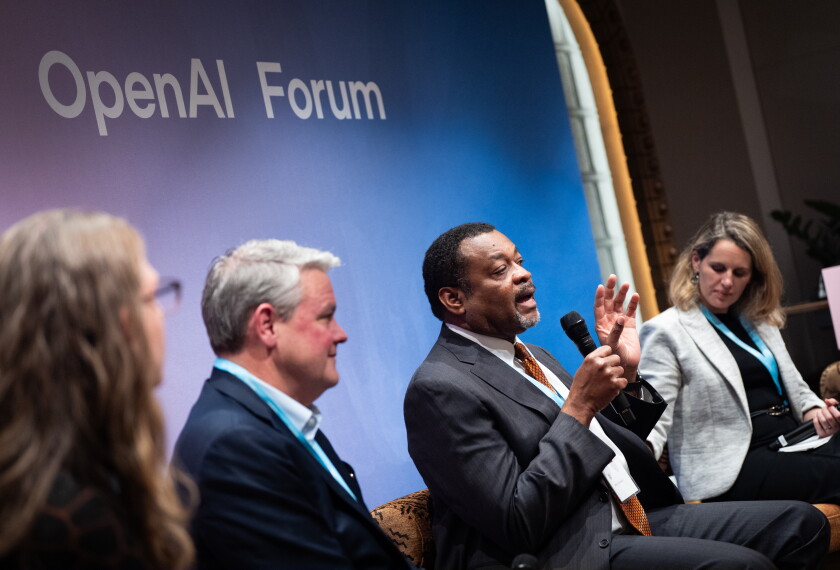
That’s according to a group of 98 high school students representing all 50 states who spent three days in Boston creating, debating, and voting on a framework for what they believe AI use in schools should look like.
It was part of the “America’s Youth AI Festival,” which took place July 17-19 and was hosted by nonprofit Day of AI; MIT RAISE; AASA, The School Superintendents Association; and the Edward M. Kennedy Institute for the U.S. Senate.
“At a time when a lot of people are scared of [AI], and the kids sometimes know more about the technology than the adults do, and the adults have failed to reach any kind of consensus on this, it’s a profound statement that the kids were able to find some consensus,” said Jeff Riley, the executive director of Day of AI, an organization that provides free AI tools, curriculum, assessments, and teacher professional development materials. “It’s a starting point for what we hope is a discussion all across the country.”
The final policy framework, titled “The STUDENTS FIRST Act,” will be shared with AASA’s network of more than 10,000 school and district leaders, and the students will also present it through webinars, workshops, public discussions, and in-person school visits with help from the event hosts.
The student-created framework comes as many school districts are in the process of crafting AI use policies and guidelines, while navigating screen-time concerns, budget shortfalls, and competing academic and student well-being priorities.
As of last fall, a majority of educators said their school or district either didn’t have policies about the use of generative AI at school by students and staff or they didn’t know if the policies existed, according to a nationally representative EdWeek Research Center survey of 693 teachers, principals, and district leaders conducted between September and November 2025.

The lack of clarity about districts’ AI-use policies is one of the top reasons many educators have yet to experiment with the quickly evolving technology. It has also led to confusion among teachers about how to handle student misuse of AI tools, according to educators.
Some federal and state lawmakers are pushing for more regulation of AI in schools. At least seven states have enacted a comprehensive policy about the use of artificial intelligence in schools, according to an Education Week tally.
“I definitely hope this [framework] is utilized,” said Marissa Donjuan, a high school senior who represented Colorado at the event. “It’s important that we start setting these rules and regulations because AI is growing super rapidly, and if it’s being used incorrectly, it can really hurt the education system as a whole.
“I’m really hoping that the work we did was a stepping stone for each individual district to do something of their own and to create something that’s meaningful and impactful to their specific communities,” Marissa added.
The STUDENTS FIRST Act emphasizes the importance of AI literacy for all
The STUDENTS FIRST Act establishes rights, protections, and responsibilities for students, teachers, administrators, and caregivers.
The students came into the event with their own set of AI policies and guidelines that they would like to see in the framework, Riley said. Staffers at the Edward M. Kennedy Institute for the U.S. Senate then put those together into a draft document as a starting point for students’ discussions.
Many of the students came in with similar concerns: ensuring kids were using AI responsibly and that they were still using their brains. These concerns are addressed throughout the framework.
“The most important provisions revolve around AI literacy and teaching teachers, students, families, administrators about AI,” Marissa said. “Because you can’t be handed something and expected to use it correctly when you don’t even understand the full extent of it—what it is, how to use it.”
The section in the framework that focuses on student responsibilities includes provisions that:
- Ensure students receive AI literacy instruction as soon as they start using digital devices in the classroom;
- Prevent students from using AI in a way that circumvents the learning process—instead, students should use it as a supplement to learning;
- Prevent students from using the technology for bullying, harassment, libel, or falsely accusing school community members;
- Ensure students have a way to appeal accusations of wrongful AI use; and
- Allow students to refuse to use AI if it is necessary for an assignment and be given an alternative assignment.

The teacher-responsibilities section emphasizes the importance of teacher judgment and teacher-student relationships. For instance, the framework says:
- Teachers can’t use AI as the sole determinant of grades, but the technology can be used as a starting point;
- There should be a clear, written policy in the syllabus for when AI use is permitted, restricted, or banned for specific assignments;
- Teachers should be transparent in their AI use just as students are required to be;
- Teachers can require an oral defense in assignments where AI use is suspected or reported to ensure students have the knowledge displayed in the work; and
- Teachers should participate in AI literacy training regularly.
Brandon Boswell, a science teacher at Cypress Bay High School in Weston, Fla., who attended the educator events at the America’s Youth AI Festival, said the student-created policy has informed his own approach to AI.
“The idea of an oral examination was not in my official policy, so I laid it out for my classes this year,” Boswell said. “There will be an AI detector, and if AI use is detected, the students need to be aware that one of the things that could happen is that I could orally examine their understanding of that content.”
For administrators, students believe they should create clear AI policies and guidelines for students and staff (including procedures for opting out of AI use), consult the whole district community before drafting these policies, and review the policies every year. Administrators should also provide AI literacy training for staff, according to the students’ framework.
Gyimah Whitaker, the superintendent of the City Schools of Decatur in Georgia who attended the educator events at the festival, said she especially likes the emphasis on teacher training.
“That provision is the groundwork for some of what I think is necessary,” Whitaker said. “Do I think it must be a state-provided AI literacy course taken every two years? Not necessarily. But the fact that the course would educate teachers on responsible AI use, academic integrity, student privacy, accessibility tools, and recognizing AI-generated work is important.”
The students had a harder time coming up with provisions for parents and guardians, said Sarah Zahka, a high school senior who represented Florida at the event. Students are more knowledgeable about their own experiences, and they also know schools don’t have authority over parents and the home, she said.
“Ultimately, we gathered there as students. It is easier to say about how the students feel, but when we take into consideration how parents may feel, that gets a little bit tricky,” Sarah said.
Still, the framework included provisions that encourage parents to reinforce healthy technology habits at home, build up their own AI literacy skills, and protect their right to know how AI is being used in their kids’ classrooms.
The student-created framework is a ‘great first step’
Students who spoke with Education Week said they know the framework isn’t perfect and that if they had more time, they could’ve addressed other challenges they know schools will face as a result of this fast-evolving technology.

For instance, funding is a big question mark that students said they didn’t really consider.
“The big focus was we need to train teachers, we need to train students, we need to get kids laptops to use AI. But we didn’t consider where this money would be coming from and how we would fund that because obviously these trainings wouldn’t be free,” Marissa said.
Districts also need time to train teachers, but “they already have so much going on,” she said.
This framework is just a starting point, the students said. In the coming weeks and months, students and educators will present it at their schools and districts to help inform their work around AI, which is still in the beginning stages for many.
“The STUDENTS FIRST Act is a great first step, a great place to begin,” said Boswell. “It also informs anybody who reads it what students think is important, and that’s a voice that’s been missing from this discussion.”
The City Schools of Decatur do not have an AI policy yet, and this framework will help district leaders “determine what would be the nuts and bolts of a policy,” said Whitaker.
Marissa is the student representative on her school board and will be presenting the framework to the board soon, she said.
“I plan on taking it to them and explaining how I think we should use it and the ways that I think it would benefit our district,” Marissa said. “I also want to bring to them the idea of the impact that it had on us to be in a room with so many different students and the ability we had to create something so important with student voice.”