Artificial Intelligence Tracker

Which States Require Schools to Have AI Policies?

Putting guardrails in place for this fast-changing technology is not easy
By Kevin Bushweller — September 23, 2025 | Updated: September 17, 2026 1 min read
Illustration of three educators in hard hats lifting up a very large letter "I" next to a large letter A.
  • Save to favorites
  • Print

Crafting policies that address the use of artificial intelligence in K-12 education is a tricky business. The technology is advancing so fast that a policy approved one year will likely need to be updated the next. And K-12 educators are far from a consensus on how the technology should be used for teaching and learning and the management of schools.

At the same time, students are experimenting with AI tools, pushing the boundaries on how much technology can be used as a learning partner on school assignments—and in many cases, using the tools to cheat and plagiarize.

And in the workplace, AI is being widely used—including in schools—to knock out emails faster, brainstorm ideas, write strategic plans, and more. For that reason, some schools are deliberately teaching students how to use artificial intelligence to prepare them for the jobs of the future.

It is in this environment that states are trying to figure out what, if any, policies or laws need to be put in place to manage the use of artificial intelligence in education. Some states have begun to take action.

At least 8 states have enacted a comprehensive policy about the use of artificial intelligence in schools, according to an Education Week tally.   

As the debate over artificial intelligence in schools continues, Education Week is tracking state-level legislation and comprehensive policies about AI use in K-12 education.


State requirements for artificial intelligence policies in schools

Follow this tracker to see what’s happening at the state level.


Resources

Dive deep into the debate on artificial intelligence in K-12 schools—bans, restrictions, classroom learning tools, and more.
Artificial Intelligence Explainer AI Literacy, Explained
Now that AI is expected to influence fields from medicine to policing, what do students need to understand about the technology?
10 min read
Photo collage of computer with pixelated image of girl.
F. Sheehan for Education Week / Getty
Artificial Intelligence Reported Essay Is There a Healthy Middle Ground on AI in Schools? Try Skeptical Optimism
How students and teachers can learn to put a human touch on everything AI produces.
13 min read
Humans and AI work together to design curriculum.
Islenia Mil for Education Week
Artificial Intelligence Video The PD Teachers Want on AI Use and Ethics
Schools and vendors have started to offer PD on the use of AI in the classroom. Here's what educators say that PD should include.
View of the back of a woman lecturer giving a presentation to Ba blurred out group of diverse adults
E+
Artificial Intelligence 5 Best Practices for Crafting a School or District AI Policy
Nearly half of educators say their school or district does not have an AI policy.
Illustration of woman teacher vetting artificial intelligence for classroom.
Weiyi Zhu/iStock/Getty
Artificial Intelligence Download 4 Strategies to Help Teachers Embrace AI in Their Work (Downloadable)
A tip sheet of recommendations for school and district leaders.
1 min read
People interact with artificial intelligence apps. AI technology helps with productivity work and study in the modern world.
Jenny on the Moon/iStock
Artificial Intelligence ‘We Need to Reimagine What We Can Do’: How Teachers Are Adapting to AI
Educators are divided on AI in classrooms, weighing its benefits for learning against risks of cheating and overreliance.
4 min read
An illustration of computer keyboard keys on a red background. One key shows the letters AI and the other key shows an arrow suggesting "repeat".
DigitalVision Vectors

A close up of a laptop and hands overlaid with AI and techie icons.
iStock/Getty
Read More
Find out how artificial intelligence could change education, inside the classroom and out.
October 23, 2024

Contact information

For media or research inquiries about this map and data or to contribute information, contact library@educationweek.org.

How to cite this page

Which States Require Schools to Have AI Policies? (2025, Sept. 23). Education Week. Retrieved Month Day, Year from https://www-edweek-org.ezproxy.baylor.edu/technology/which-states-require-schools-to-have-ai-policies/2025/09

Reporting/analysis: Holly Peele

Coverage of education technology is supported in part by a grant from the Chan Zuckerberg Initiative, at www.chanzuckerberg.com. Education Week retains sole editorial control over the content of this coverage.

Events

This content is provided by our sponsor. It is not written by and does not necessarily reflect the views of Education Week's editorial staff.
Sponsor
School Climate & Safety Webinar
There But Not Present: Rethinking Student Engagement
Learn how to recognize the early signs of disengagement and what the behavioral science reveals about which interventions actually work.
Content provided by Frontline Education
Teacher Preparation Webinar What Teacher Education Should Look Like in the Age of AI
Explore the current trends around the use of AI in teacher preparation and continuing education with data from the EdWeek Research Center.
English Learners Webinar How Can School Districts Better Support English Learners With Disabilities?
Join this webinar to hear recent findings from the EdWeek Research Center and discover practical strategies for improvement.

EdWeek Top School Jobs

Teacher Jobs
Search over ten thousand teaching jobs nationwide — elementary, middle, high school and more.
View Jobs
Principal Jobs
Find hundreds of jobs for principals, assistant principals, and other school leadership roles.
View Jobs
Administrator Jobs
Over a thousand district-level jobs: superintendents, directors, more.
View Jobs
Support Staff Jobs
Search thousands of jobs, from paraprofessionals to counselors and more.
View Jobs

Read Next

Artificial Intelligence A Reckoning on Social Media Addiction Came Late for Kids. Will AI Safety Be Different?
Efforts to make social media safer offer lessons for those looking to protect children using AI.
5 min read
Kristin Bride, right, mother of 16-year-old Carson Bride, who died by suicide after being cyber-bullied on an anonymous app on Snapchat, is joined by Amy Neville, left, mother of 14-year-old Alexander Neville, who died from fentanyl poisoning after being deceived by a drug dealer operating on Snapchat, during a Social Media Victims Remembrance Day memorial on Capitol Hill, June 23, 2026, in Washington.
Rod Lamkey, Jr./AP
Artificial Intelligence Opinion Think Your Students Know More About AI Than You Do? Read This
Here are four things your students don’t understand about AI—and what you can do about it.
Sam Wineburg & Nadav Ziv
•
4 min read
102026 opinion Wineburg AI media literacy
Vanessa Solis/Education Week + Getty
Artificial Intelligence ChatGPT's 'Teen Mode' Is Unsafe for Students, Report Concludes
The chatbot failed to report unsafe interactions to parents in a timely manner, researchers found.
5 min read
Young man using a smartphone to ask an AI about exercise
Vanessa Solis/Education Week + Getty
Artificial Intelligence At OpenAI Forum, Discussion Focuses on Stronger Teen Safety Measures
Panelists put forward ideas on how to incentivize industry to develop responsible products.
4 min read
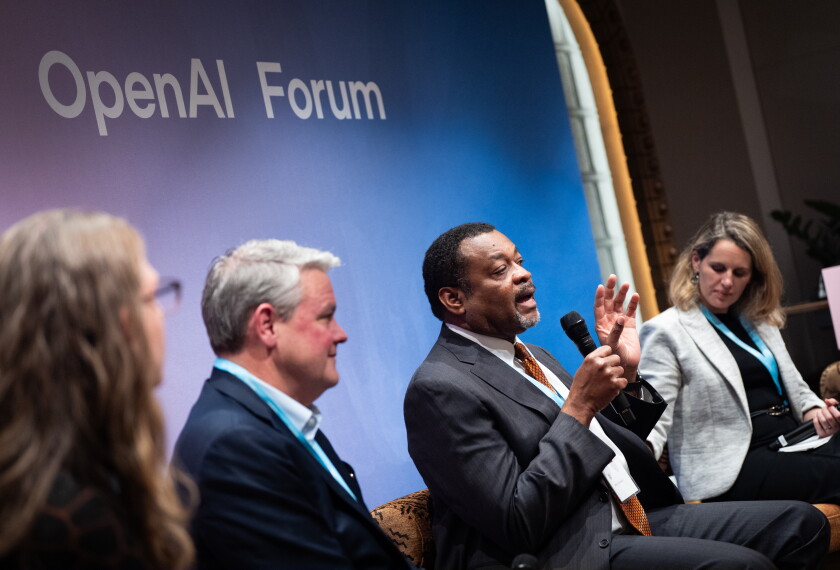
Washington, DC - October 5, 2026: Arthur C. Evans Jr., PhD, Chief Executive Officer of the American Psychological Association  speaks during the discussion. The OpenAI Forum hosted a panel on Responsible AI for Teens, how AI can support teens’ learning while promoting safe, healthy use. The program featured an OpenAI Forum panel with experts in learning, adolescent mental health, and family and online safety: Kate Ruane, Director of the Free Expression Project at the Center for Democracy & Technology, Chuck Melley, SVP of Policy, Advocacy and Communities at CodeAI, Arthur C. Evans Jr., PhD, Chief Executive Officer of the American Psychological Association and Mathilde Cerioli, Chief Scientist at everyoneAI. Chris Lehane, OpenAI’s Chief Global Affairs Officer, moderated the conversation and shared context on ChatGPT for Teens, a learning-first experience launched in August and designed to help teens think critically, deepen understanding, and use AI with confidence.
Arthur C. Evans, Jr., the CEO of the American Psychological Association, speaks on a panel at an Oct. 5, 2026, OpenAI forum on how to support responsible use of AI among teenagers.
Sarah Voisin for Education Week