Classroom Technology

What Are the Best Ways to Manage Cellphones in Schools?

By Arianna Prothero — February 14, 2025 3 min read
Image of someone holding a cellphone.
  • Save to favorites
  • Print

As educators and politicians alike call for reigning in students’ cellphone use in schools, an important question remains unanswered: What approach works best?

Because this issue is so new, there’s little research on the most effective policies. Should schools ban cellphones from bell-to-bell? Or instead allow students’ access to their devices while focusing on educating them about healthy tech habits?

Research on how cellphone policies work in schools in the United States is especially hard to find. So, Education Week asked Adam McCready, an assistant professor in residence at the University of Connecticut’s Department of Educational Leadership, to share some of the early findings from a study he currently is working on.
See also

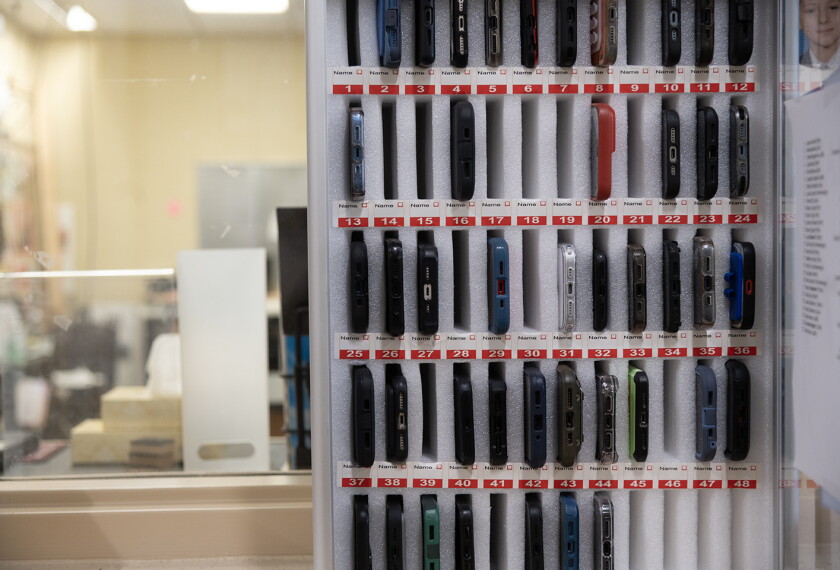
Cell phones sit in a cell phone locker at Boys’ Latin School of Maryland in Baltimore on Oct. 24, 2024.
Jaclyn Borowski/Education Week

For his study, McCready is evaluating the effects of cellphone policies (or lack thereof) in four middle schools in Connecticut. One school has no formal cellphone policy, one requires students to lock their phones up all day, one is implementing a digital literacy curriculum, and the fourth one is both storing phones for the whole school day and using a digital literacy curriculum.

This interview has been edited for length and clarity.

What do your early findings show about cellphone policies?

Adam McCready

We have some preliminary findings. I share these cautiously, because they’re pretty early. In the school we’re looking at that has [an all-day cellphone] prohibition, [but] no [digital literacy] education, we didn’t really see phones out through the day. [But] we did see students in front of us misusing school technology to play online video games. We saw students using Google Docs to write notes back and forth to one another. They still have devices in front of them throughout the school day.

At the dismissal, what was notable is that as students get dismissed, they unlock their phones, and then the first thing they do is they’re head down in the phone walking out of the school. So behavior changes at end of the day.

We’re going to continue to look at [this] in our data: yes, the phones change behavior during the school day, but it’s likely doing little to address behavior outside of school. And those behaviors then bleed into and affect the school day. If students are still getting bullied through social media in the evening, that still has an effect on students regardless.

What are the pros and cons of state-level cellphone policies for schools?

Frankly, there’s not a lot of scholarship out there at this point in time on this topic. I do think that these prohibitions may have some benefit related to certain in-school outcomes. It may help students be more attentive or engaged in curriculum, it might change certain behaviors within the school day.

See also

cellphone distraction policy bans in schools static
Laura Baker/Education Week via canva

My team and I really do feel, though, that any kind of prohibition needs to be paired with some form of education. The analogy I often give is that if we’re preventing access and simply giving the devices back, it’s like handing a kid a license at 16 and just saying, you can drive a car now without any kind of [driver training] education.

What are best practices that you’ve observed through your research so far?

Recognizing that probably even education that begins in late elementary school or middle school is likely too late.

[Another] challenge is, how do you create curriculum that’s customized and relevant? And that actually might vary from district to district or school to school. I don’t think there can be a universal curriculum that can be implemented that will actually have the efficacy folks are looking for. Because there’s just so many contextual differences in the needs of students based on different identities and lived experiences from district to district, or school to school, that really creates a challenge in implementing a universal curriculum on this topic.

One other thing: we interviewed teachers, administrators, school counselors, parents, and caregivers about their perceptions of these relationships and efficacy of interventions. And almost universally, folks acknowledge that adult role modeling is part of the problem. We even noticed in our observations is that even when you prohibit students from using the devices, they’re still watching teachers on their phones in the school. It’s a very mixed message.

Related Tags:

Events

This content is provided by our sponsor. It is not written by and does not necessarily reflect the views of Education Week's editorial staff.
Sponsor
Assessment Webinar
Measuring What Matters: How District Leaders Are Redefining Student Assessment
In this panel discussion, district leaders and systems experts will examine the gap between the outcomes we want and the systems in place.
Content provided by Otus
Early Childhood Webinar Selling Into Early Learning: New Survey Data and Strategies for Marketers
Selling into PreK? Get fresh EdWeek Research Center data and strategies to position your products and reach the right early learning buyers.
Artificial Intelligence Webinar AI and 'Techlash' Are on a Collision Course. How Should Schools Respond?
Learn what strategies and tactics schools can develop to encourage smart and responsible AI use, while also enforcing tech guardrails.

EdWeek Top School Jobs

Teacher Jobs
Search over ten thousand teaching jobs nationwide — elementary, middle, high school and more.
View Jobs
Principal Jobs
Find hundreds of jobs for principals, assistant principals, and other school leadership roles.
View Jobs
Administrator Jobs
Over a thousand district-level jobs: superintendents, directors, more.
View Jobs
Support Staff Jobs
Search thousands of jobs, from paraprofessionals to counselors and more.
View Jobs

Read Next

Classroom Technology Are Teens Starting to Accept Cellphone Bans? A New Survey Has Answers
Researchers surveyed teens and adults on how well school cellphone policies were enforced over the course of a school year.
5 min read
Students use their cellphones as they leave for the day the Ramon C. Cortines School of Visual and Performing Arts High School in downtown Los Angeles, Aug. 13, 2024.
Students use their cellphones as they leave the Ramon C. Cortines School of Visual and Performing Arts High School in downtown Los Angeles on Aug. 13, 2024. A new set of surveys of teen attitudes toward school cellphone restrictions shows growing acceptance of the policies by those most directly affected.
Damian Dovarganes/AP
Classroom Technology Opinion The Big Flaw With Ed-Tech Tutoring Isn't Technological
Before focusing on the technology, we need to redesign the learning model, Michael Horn argues.
•
4 min read
The United States Capitol building as a bookcase filled with red, white, and blue policy books in a Washington DC landscape.
Luca D'Urbino for Education Week
Classroom Technology Q&A Students’ Tech Engagement Doesn’t Equal Learning, Psychologists Warn
A panel of psychologists shares recommendations for ensuring technology promotes meaningful learning.
6 min read
DSC03088
Students at a high school in Plymouth, Ohio work on how to properly prompt the Gemini AI app on Aug. 28, 2026. A new report of the American Psychological Association warns that student engagement with tech apps should not be conflated with benefits for learning.
Ruddy Roye for Education Week
Classroom Technology Q&A Facing 'Techlash,' How Should Schools Talk to Parents About Tech Use?
A school communications expert explains how schools should approach their messaging around tech.
5 min read
MEAD, CO - AUGUST 18: Parents watch and and take photos of their kids as they enter the school during their first day of class at the Big Sky PK-8 School in Mead on Aug. 18, 2026.
Parents watch their kids as they enter the school on the first day of class at the Big Sky PK-8 School in Mead, Colo., on Aug. 18, 2026. As schools face growing backlash from parents over their use of educational technology, a school communications professional has some pointers on how schools can communicate with parents about how they're using technology.
Joel Solis/MediaNews Group/Boulder Daily Camera via Getty Images