Student Absenteeism

Chronic Absenteeism Is a Crisis. Do Parents Get It?

By Evie Blad — March 29, 2024 3 min read
Photo from behind of a mother with her arms around her son and daughter who are both wearing school bookbags.
  • Save to favorites
  • Print

A majority of parents and caregivers of students with high rates of school absences are not concerned about their children’s missed school days, new research finds.

The findings by researchers at the University of Southern California come as schools take on the uphill battle of bringing down rates of chronic absenteeism that doubled during the COVID-19 pandemic. They suggest schools are facing a shift in attitudes toward absenteeism and need more targeted and effective messaging to help families rebuild strong attendance habits.

“If schools and districts are concerned about children’s absenteeism, they need to reach out to parents clearly, in ways that they understand,” said Morgan Polikoff, a professor of education at USC. “And they need to try and get to the bottom of what’s driving absenteeism, which is probably going to differ from kid to kid.”

Polikoff and fellow researchers surveyed parents and caregivers in 2,479 households between December 2023 and February 2024 to ask them about their children’s absences.

Five percent said their child had missed more than 10 days in the first semester of the 2023-24 school year, which meets the most common definition of chronic absenteeism: missing 10 percent or more school days in a year. Fewer than half of those respondents, 47 percent, said they were concerned about their child’s absences.

Eleven percent of respondents said their child had missed six to 10 days in the first semester, putting them at risk of chronic absenteeism, the USC researchers wrote in a March 26 brief for the Brookings Institution. Of those parents and caretakers, 29 percent reported concern about their child’s attendance.

Absenteeism rates remain high

National data on chronic absenteeism suggest respondents to the USC survey underreported—or weren’t aware of—the extent of their children’s school absences, the researchers wrote in a March 26 brief for the Brookings Institution.

National rates of chronic absenteeism doubled during the pandemic, reaching nearly 30 percent during the 2021-22 school year, according to Attendance Works, an organization that advocates for tracking and addressing student attendance. State data shows schools made some progress in bringing those numbers down during the 2022-23 school year, but they remain well above pre-pandemic levels in most places.

Concerns about parents understanding of attendance mirror a “perception gap” identified in previous research that found parents may not be aware of their children’s need for tutoring and academic acceleration following pandemic learning interruptions.

Poor student attendance patterns are affected by a range of systemic issues including poverty, healthcare coverage, and access to reliable transportation.

Education advocates have urged schools to take a multi-pronged approach to the problem that includes effective communication with families—everything from text message “nudges” that update parents on how many school days their child has missed, to districtwide campaigns about how attendance contributes to child well-being, to tailored strategies like home visits.

Previous research suggests the importance of a strong school-family relationship. An October study by the organizations Learning Heroes, an organization that studies parent attitudes about education, and TNTP, an organization that promotes effective teaching, found that schools where parents reported higher levels of trust in pre-pandemic surveys experienced lower levels of absenteeism after COVID-19 interruptions.

The USC survey data illuminates the challenges of crafting effective messages for parents. Respondents with children who were chronically absent or at risk of chronic absenteeism often did not identify a single, dominant reason for their absences.

Schools may benefit from explaining the value of in-person attendance, even if make-up assignments and classroom materials are available online, the researchers said.

Thirty-two percent of overall respondents said they weren’t concerned about absences because “everything their child needs to know is available online,” the survey found. Of respondents whose children missed six or more school days, 33 percent said they believed it was OK for their child to work from home if they preferred.

Related Tags:

Events

This content is provided by our sponsor. It is not written by and does not necessarily reflect the views of Education Week's editorial staff.
Sponsor
Personalized Learning Webinar
Differentiation That Delivers: Proven Practices From High-Growth Districts
Make every minute count. Proven strategies from educators and leaders driving real student growth. Save your seat!
Content provided by i-Ready, Curriculum Associates
This content is provided by our sponsor. It is not written by and does not necessarily reflect the views of Education Week's editorial staff.
Sponsor
College & Workforce Readiness Webinar
From Exposure to Experience: Designing Accessible Work-Based Learning
Learn how schools can create meaningful experiences that help every student build skills, connections, and a clearer path to their future.
Content provided by Project Lead The Way
This content is provided by our sponsor. It is not written by and does not necessarily reflect the views of Education Week's editorial staff.
Sponsor
School & District Management Webinar
A Tale of Two School Districts: Forecasting Enrollment
Forecasting enrollment is hard. Here’s how two different districts are navigating times of change with data that considers the whole picture.
Content provided by Zonda Education

EdWeek Top School Jobs

Teacher Jobs
Search over ten thousand teaching jobs nationwide — elementary, middle, high school and more.
View Jobs
Principal Jobs
Find hundreds of jobs for principals, assistant principals, and other school leadership roles.
View Jobs
Administrator Jobs
Over a thousand district-level jobs: superintendents, directors, more.
View Jobs
Support Staff Jobs
Search thousands of jobs, from paraprofessionals to counselors and more.
View Jobs

Read Next

Student Absenteeism How to Get Past the Blame Game when Kids Refuse to Come to School
Tackling school avoidance won’t be a one-person job, experts say.
5 min read
A crossing guard stops traffic as a parents accompany their children back to school on the first day of New York City Public Schools 2025-2026 scholastic year, in the New York City borough of Queens, NY, September 4, 2025.
A crossing guard stops traffic as a parents accompany their children back to school on the first day of the 2025-26 school year in New York City, in the borough of Queens, N.Y., on Sept. 4, 2025. The New York City district is appointing school avoidance liaisons to tackle the problem of students with social or emotional disabilities refusing to go to school.
Anthony Behar/Sipa via AP
Student Absenteeism A New Tool Can Predict Absenteeism—Before It's Chronic
A researcher-made tool takes student data into account to predict the risk of chronic absences.
4 min read
20260420 AMX US NEWS CRADLE CAREER BIRMINGHAM FORMS COMMISSION 1 AMG
The hallways of a school in Birmingham, Ala., on April 2, 2026. A new tool developed by the American Enterprise Institute allows schools to input student attendance data and other information to gauge their risk of chronic absenteeism—early in the school year before absences have piled up.
Will McLelland/AL.com via TNS
Student Absenteeism Chronic Absenteeism Is Linked to Slower Academic Recovery in Math, Reading
A new study adds to the evidence base suggesting attendance is a key to raising student achievement.
3 min read
MVCS 5100
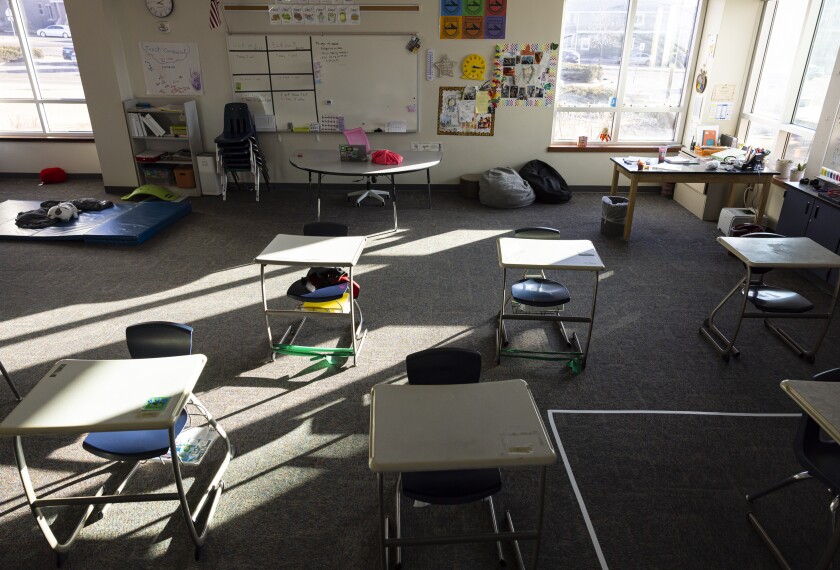
Research confirms what many educators know: chronic absenteeism undermines student academic recovery. A view of an empty classroom at a school in Colorado Springs, Colo., Feb. 12, 2026.
Kevin Mohatt for Education Week
Student Absenteeism The Data Hiding in Plain Sight That Could Help Schools Fight Chronic Absenteeism
A granular look at attendance data could help schools fight mounting absences, a new report says.
4 min read
Chronic Absenteeism Indigenous Students 24276591105046
Social worker Mary Schmauss, right, greets students as they arrive for school on Oct. 1, 2024, at Algodones Elementary School in Algodones, N.M. A new report says a deep look at attendance data could point schools toward strategies that could help them lower stubbornly high chronic absenteeism.
Roberto E. Rosales/AP Photo