Student Well-Being & Movement

Yes, Computer Science Can Teach Social-Emotional Skills. Here’s How

By Arianna Prothero — July 10, 2026 2 min read
Education Teacher Appreciation Morale 24126158566435
  • Save to favorites
  • Print

When people think about computer science class, they likely conjure up images of ones and zeros—not mindfulness. But there are many ways computer science can support student mindfulness and social-emotional learning, and vice versa.

For one, computer science is all about trying things, failing, and trying again—giving students ample opportunity to learn how to manage their emotions and build resilience, said Nadia Taylor, a computer science implementation specialist in the office of student pathways for the New York City schools.

“Students, when they encounter bugs when they’re programming, they’re frustrated, they’re angry, they’re sometimes embarrassed,” she said. “They’re getting all of these different emotions because they put so much hard work into creating a program and they’re finding a mistake.”

That’s where social-emotional learning can be useful.

Building social-emotional skills can help students not only pinpoint the emotions they have, but also give them strategies to manage them productively, Taylor said.

Taylor presented on this topic at the ISTELive 26 + ASCD annual conference in Orlando, Fla., in June.

Social-emotional learning has an important place in computer science—and other STEM—classes beyond just being a tool students use to help solve problems. As a classroom teacher, Taylor used digital mood meters so students could share with her and the class how they were feeling that day.

“This is something that we were able to save, and then I would be able to look at it later on and even do a quick assessment just to check in on the students,” she said. Mood meters can and often are done on paper, but Taylor said she preferred having digital data that was harder to lose and made it easier to track trends.

Even in a class where the point is for students to use digital devices, teachers still must think about students’ overall wellness and take tech breaks to let them move around or even just give their minds a rest, said Sean Arnold, the director of school pathways for the New York City district, who presented with Taylor.
See also

Empathy02
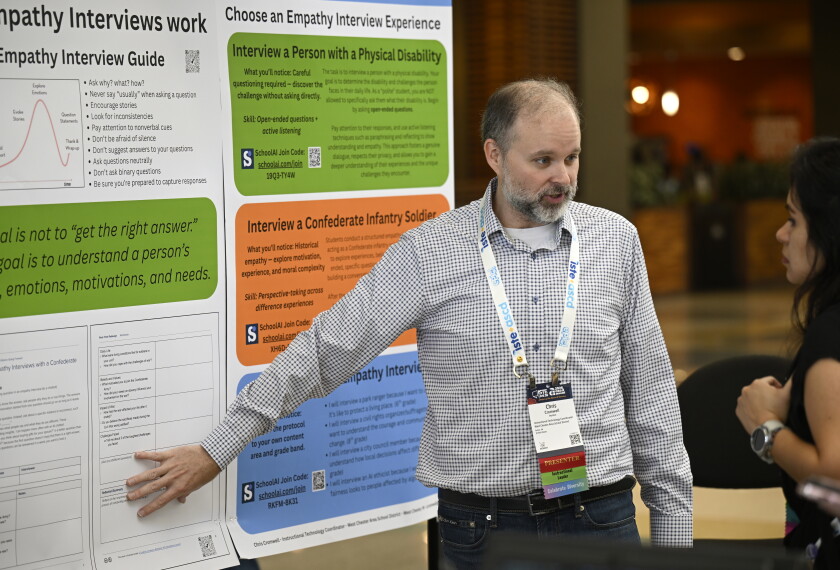
Chris Cromwell, an instructional technology coordinator for the West Chester Area School District in Pennsylvania, speaks to attendees during his presentation at the ISTELive 26 + ASCD Annual Conference in Orlando, Fla., on July 1, 2026. Cromwell is one of a small but growing number of educators using AI to teach students social and emotional skills.
Marvin Joseph/Education Week

“Whether it is a little yoga break, even if it’s in your chair, even if you’re not mobile, brain break activities [for] students need to be built into everyone’s day,” he said, “especially with young people because otherwise your brain can’t process the things that came before and can’t prepare for the things that are coming next.”

Finally, there are also popular teaching tools used in computer science that can support social-emotional learning both in computer science and other subjects, said Taylor. One example: rubber ducky debugging.

This is a problem-solving strategy in which the programmer talks to a rubber ducky or other inanimate object and describes their code line by line. By articulating aloud what they’re doing, it becomes easier to spot mistakes. This approach helps students build important social-emotional skills such as problem-solving, iterating on their ideas, and independence.

Teachers in any subject can use this strategy, Taylor said, and it doesn’t have to be done with rubber ducks. An English/language arts teacher can have students read their essays aloud to stuffed animals to help them catch punctuation errors.

“Even though they’re really talking to themselves, they’re noticing what’s going on and they’re catching those mistakes as they’re talking about it,” she said. “I was a big fan of ‘ask three before me:’ ask yourself and the duck, then ask the person next to you, and then if you need to, you come to me last. ... We really want to build that independence.”

Events

This content is provided by our sponsor. It is not written by and does not necessarily reflect the views of Education Week's editorial staff.
Sponsor
School Climate & Safety Webinar
There But Not Present: Rethinking Student Engagement
Learn how to recognize the early signs of disengagement and what the behavioral science reveals about which interventions actually work.
Content provided by Frontline Education
Teacher Preparation Webinar What Teacher Education Should Look Like in the Age of AI
Explore the current trends around the use of AI in teacher preparation and continuing education with data from the EdWeek Research Center.
English Learners Webinar How Can School Districts Better Support English Learners With Disabilities?
Join this webinar to hear recent findings from the EdWeek Research Center and discover practical strategies for improvement.

EdWeek Top School Jobs

Teacher Jobs
Search over ten thousand teaching jobs nationwide — elementary, middle, high school and more.
View Jobs
Principal Jobs
Find hundreds of jobs for principals, assistant principals, and other school leadership roles.
View Jobs
Administrator Jobs
Over a thousand district-level jobs: superintendents, directors, more.
View Jobs
Support Staff Jobs
Search thousands of jobs, from paraprofessionals to counselors and more.
View Jobs

Read Next

Student Well-Being & Movement Opinion Why I’m Bringing TikTok Dances to My P.E. Class
Physical education needs an update. Here’s how I’m engaging the students who have been left out.
Dedric Wright
•
5 min read
Inclusive physical education, alternatives
Tatjana Junker for Education week
Student Well-Being & Movement Teen Mental Health Is Improving, CDC Finds. Then Why Are Experts Still Concerned?
Student mental health remains a big challenge for schools to address.
5 min read
Student sitting criss cross pondering.
Collage by Laura Baker/Education Week + Getty
Student Well-Being & Movement Skimping on Recess Won't Fix Test Scores, Experts Say
Parent advocates are spreading the research-backed message: Kids need to move during the school day.
5 min read
HOUSTON, TEXASA - MARCH 18: Students play in the playground of Iman Academy Southwest is photographed on Tuesday, March 18, 2025 in Houston.
Students play in the playground of Iman Academy Southwest on March 18, 2025 in Houston. Across the country, many schools prioritize instructional time over recess—despite research that shows opportunities for play can improve academic performance.
Raquel Natalicchio/Houston Chronicle via Getty Images
Student Well-Being & Movement Opinion It's Football Season. That Matters More to Schools Than It Should
How did athletics beat out academics as the highest priority for public schools?
Robert Maranto
•
4 min read
Image of two students walking down a hall in isolation and in the background, you see silhouettes of a women's lacrosse team celebrating together in a huddle.
Laura Baker/Education Week + Getty
