

Democrats will retake Congress in January after winning key battleground races across the country—and with it, the reins on federal K-12 policymaking and oversight.
With their new power, Democratic lawmakers have pledged to try to reverse the Trump administration’s moves to dismantle the U.S. Department of Education, gut education research and grants, and enlist federal civil rights agencies in conservative culture wars.
Still, President Donald Trump will remain in the White House for two more years. That means K-12 legislation will likely need at least some bipartisan support to make it across the finish line.
In the upper chamber, Sen. Bernie Sanders, an independent from Vermont who caucuses with the Democrats, is poised to take the helm of the Senate Health, Education, Labor and Pensions Committee. He chaired the panel from 2023 to 2025 and currently serves as its ranking member.
Leadership of the House panel is more of a question mark. Rep. Bobby Scott, D-Va., the current ranking member and former chairman of the House Education Committee, will seek to lead the committee.
But he’ll have competition from fellow Democrats Rep. Suzanne Bonamici of Oregon, currently the top Democrat on the subcommittee that deals with K-12 policy, and, potentially, Rep. Jahana Hayes of Connecticut, a former national teacher of the year.
Here’s what educators can expect now that divided government has returned to Washington:

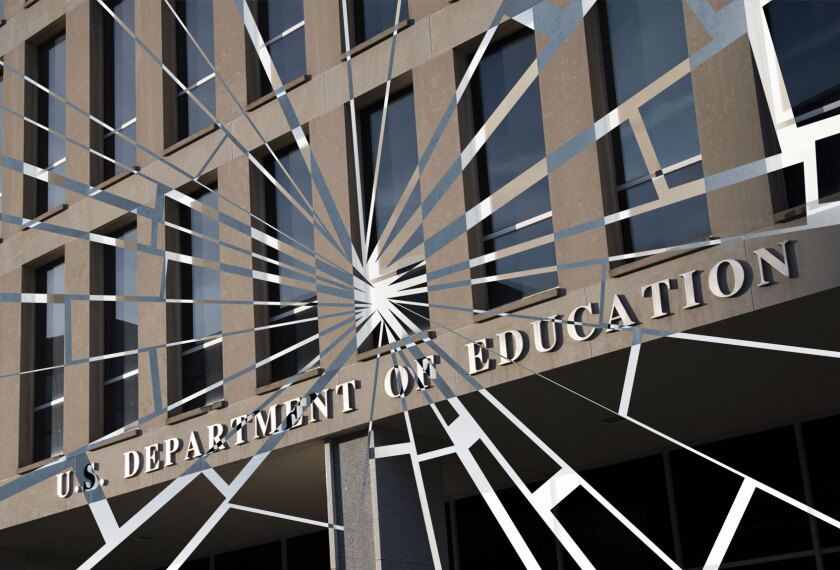
Democrats may try to stop Trump from dismantling the U.S. Department of Education
The Trump administration hasn’t officially gotten rid of the 46-year-old department, but it’s slashed the agency’s staff nearly in half, and shifted major K-12 programs, including Title I grants for disadvantaged students and career and technical education funds, to the U.S. Department of Labor.
The Department of Health and Human Services is now responsible for special education. And the Justice Department oversees enforcement of education civil rights laws.
A standalone bill nixing those moves would be subject to Trump’s veto. But Democrats—perhaps with support from a few Republicans—could add language reversing those transfers to a broader spending bill.
That would force Trump to “decide whether [to] shut down the federal government or bring the people back to the Department of Education,” Scott said in an interview last month.
Putting language in a funding bill to stop the interagency agreements is something Sens. Tim Kaine, D-Va., and Chris Van Hollen, D-Md., have also floated, Politico reported.

Oversight hearings are a sure thing
Even if Democrats don’t succeed in restoring programs to the Education Department through legislation, both Scott and Bonamici said they’d like to draw attention to problems they say the moves have created for educators and students—including big changes to civil rights enforcement.
“One of the first things to do is to get information about what’s happening with these interagency agreements,” Bonamici said in an interview last month.
Scott suggested other areas of oversight would include Trump administration policies on gun violence, child nutrition, civil rights enforcement, and federal education research.
“They’ve cut back on research, eliminated it, basically,” Scott said.
Sanders is on a similar wavelength. Back in April, he released a report showing that Trump’s Education Department had not resolved any civil rights cases involving sexual harassment, sexual violence, seclusion and restraint, racial harassment, or discriminatory school discipline—despite having 2,700 such cases pending .
Scott also wants to probe implementation the Every Student Succeeds Act, which he helped craft and which passed with bipartisan support in 2015.
The Trump administration has issued a series of waivers giving states leeway from some of ESSA’s fiscal requirements. State leaders argue this flexibility will help them target funds to statewide school improvement efforts, while civil rights groups argue it will steer money away from historically disadvantaged groups of students.

Get ready for gridlock on K-12 legislation?
Democrats will now have the votes to pass legislation that showcases their vision for K-12—but it’s hard to imagine the Trump administration jumping on board with their favored policies.
Scott has long pushed for a significant federal investment in school construction and digital infrastructure. He’d also like to help school districts voluntarily expand diversity initiatives and restore parents’ rights to hold school districts accountable for policies that deny students of a particular race or ethnicity equitable access to a high-quality education.
And Bonamici recently introduced sweeping K-12 legislation that would fund special education grants at levels promised when Congress passed the first sweeping special education law in the 1970s. Her proposal would also triple Title I funding; examine how states and districts use standardized testing, with an eye toward eliminating unnecessary assessments; and promote project-based learning, career-technical education, and universal pre-kindergarten.
Sanders, who blames school staffing shortages in part on low teacher pay, has introduced legislation to set a minimum $60,000 annual salary for teachers and to triple Title I funding.
“Salaries for incoming teachers are just pathetically low,” Sanders told Education Week in 2023, when he took the helm of the HELP committee for the first time.
What’s more, both Bonamici and Scott have signed onto a bill, sponsored by Rep. Gwen Moore, D-Wis., that seeks to repeal the Trump administration’s new tax-credit scholarship program. And Sanders is cosponsoring a similar bill in the Senate, introduced by Democratic Sens. Mazie Hirono of Hawaii and Mark Kelly of Arizona.
Squelching the program may be a tough sell, though, given that 31 states have already opted in, including Democrat-led Colorado and New York.

Under the program, the first of its kind, taxpayers will be able to contribute to organizations in participating states that give out K-12 scholarships and receive dollar-for-dollar federal tax credits in exchange. The scholarship-granting organizations can give out awards to cover private-school tuition and some expenses tied to public school.
Education technology, though, could be one area of bipartisan cooperation.
Bonamici hopes to get bipartisan support for an AI bill that would prohibit student data from being used to train AI models, require risk assessments of AI-powered education technology, and call for parental notification that their children are using AI tools while giving parents the option to opt out.
Scott worked with Republicans on ESSA and hopes to do so again, he said.
“There’s always room for bipartisanship if the goal is to advance education,” he said.

Some other K-12 election night takeaways
- Democrats had flipped four governors’ offices held by Republicans early Wednesday morning, in Georgia, Iowa, Ohio, and Texas—all states that have passed expansive private school choice policies in recent years.
- Democrats also claimed the state superintendent’s seat in Georgia, with Lydia Powell ousting incumbent Richard Woods. The Democratic candidate for state superintendent in Arizona, Teresa Leyba Ruiz, was also leading her Republican opponent, Kimberly Yee, early Wednesday.
- A major facet of Trump’s K-12 agenda, restricting transgender athletes’ participation in school sports, was the subject of four state ballot measures this fall. By early Wednesday, the restrictions had majority support in all four states where they were on the ballot—Arizona, Colorado, Nebraska, and Washington—though not all votes had been tallied.


