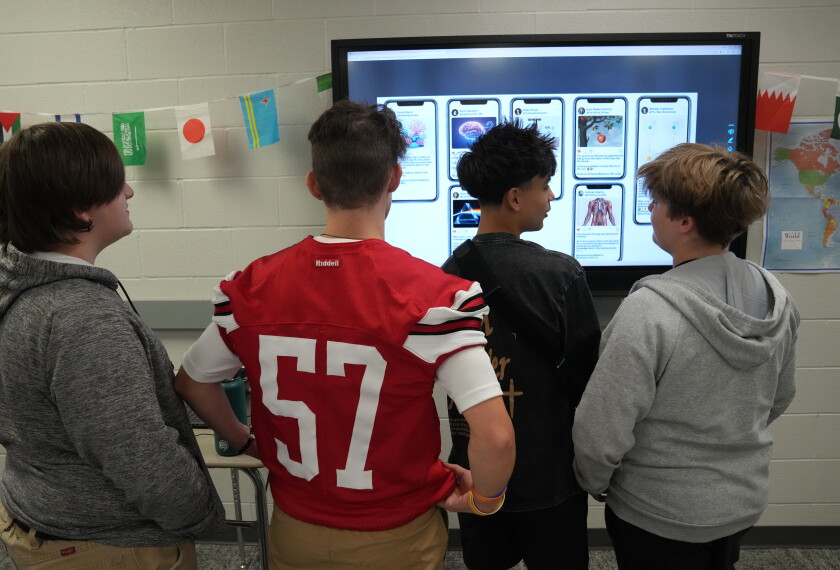
The Los Angeles Unified School District has launched an AI-powered learning tool that will serve as a “personal assistant” to students and their parents.
The tool, named “Ed,” can provide students from the nation’s second-largest district information about their grades, attendance, upcoming tests, and suggested resources to help them improve their academic skills on their own time, Superintendent Alberto Carvalho announced March 20. Students can also use the app to find social-emotional-learning resources, see what’s for lunch, and determine when their bus will arrive.
Ed, which is available 24/7 and in multiple languages, is part of the 420,000-student district’s effort to catch students up on any unfinished learning from the pandemic. It uses artificial intelligence to report on key academic metrics for each student and then creates individualized plans based on that information.
“It is the power of this technology through Ed, that we will meet every one of our students where they are and accelerate them academically and in terms of enrichment towards their full potential,” Carvalho said at the rollout event.
It comes a little more than a year after ChatGPT, an AI-powered tool that can answer seemingly any prompt, burst onto the K-12 scene. LAUSD isn’t the only district thinking about ways to harness this technology for staff, students, and families. Other districts, such as Arcadia in California, are also working on their own AI-powered chatbots. Some education organizations, such as the International Society for Technology in Education, are working on their own chatbots, too.
It’s “exciting to see a school district taking something that is pervading the world and applying it this quickly,” said Leigh Ann DeLyser, the executive director and co-founder for CSforALL, a nonprofit organization that seeks to expand computer science education.
Torrey Trust, a professor of learning technology at the University of Massachusetts Amherst, said that LAUSD’s way of bringing in information together so parents and students can understand it better and easily access it can be “beneficial” and has “really great potential.”
“But, really, with any AI [tool], we’ve got to be critical. You can’t just accept this is an amazing tool that’s going to transform your life,” Trust said.
LAUSD developed Ed through a public-private partnership with AllHere, a developer of AI-powered digital applications. The Boston-based ed-tech company won a $6 million contract over five years to guide the LAUSD effort, the Los Angeles Times reported.
Ed has undergone pilot testing with about 1,000 LAUSD students since January, according to the newspaper.
Superintendent addresses concerns about artificial intelligence
For now, Ed will be available to 55,000 students at select schools, Carvalho said. It will be launched for all students in what could be “just a matter of weeks,” after they’ve reached “a level of confidence” in the success of the platform, he added.
In his speech about the launch of the new AI tool, Carvalho addressed some of the concerns he anticipated students, parents, and ed-tech experts might have:
- Ed is not meant to replace teachers, counselors, or other staff members.
- District staff will conduct ongoing reviews of students’ and parents’ exchanges with Ed to flag any concerning content and notify the appropriate staff to respond and support.
- The district has put filters in place to ensure students are not exposed to violent or inappropriate content.
- All of the data that Ed receives and trains on remains within the district’s system.
The district’s FAQ page about Ed also specifies that only students over the age of 13 who have completed the district’s digital citizenship course on AI are able to access Ed’s chatbot features.

But experts say they still have a lot of questions.
“There’s no transparency about what data from students has been brought into this tool and how the AI is using that data to make recommendations,” Trust said. There have also been “very problematic uses of AI for predictive measures” of whether a student will graduate.
“What kind of biases is this tool going to perpetuate?” Trust said.
Even though Ed is designed to help students learn, Trust is concerned that it will be pulling data that is specific to each student, which raises concerns that some of that information could be used to discipline students, based on research from the Center for Democracy and Technology. That research shows that traditionally marginalized students are more likely to be disciplined as a result of technologies that track individual students.
DeLyser said she wants to know how the district is going to monitor Ed’s performance “out in the messy world, where the whole reason for Ed is to support parents who don’t already know the answer” and might not have the knowledge about AI prompt engineering to best use the system and help their children use it.

Experts expressed caution when asked whether other districts should follow LAUSD’s lead.
Trust said someone who can bring a critical perspective needs to research the approach “before we can say whether it’s great or not” and “before it could be recommended to other school districts.”
For Elizabeth Laird, the director of the nonprofit Center for Democracy and Technology’s Equity in Civic Technology project, the answer depends on each district’s context and community. Districts should ask: What are the most pressing issues facing our students, and does the community believe that this kind of technology is the solution?
If this is the solution that districts want to use, the blueprint of how LAUSD got to this point could be “a roadmap” for how they could implement their own, DeLyser said.