Artificial Intelligence

Students Are Worried That AI Will Hurt Their Critical Thinking Skills

By Arianna Prothero — March 23, 2026 4 min read
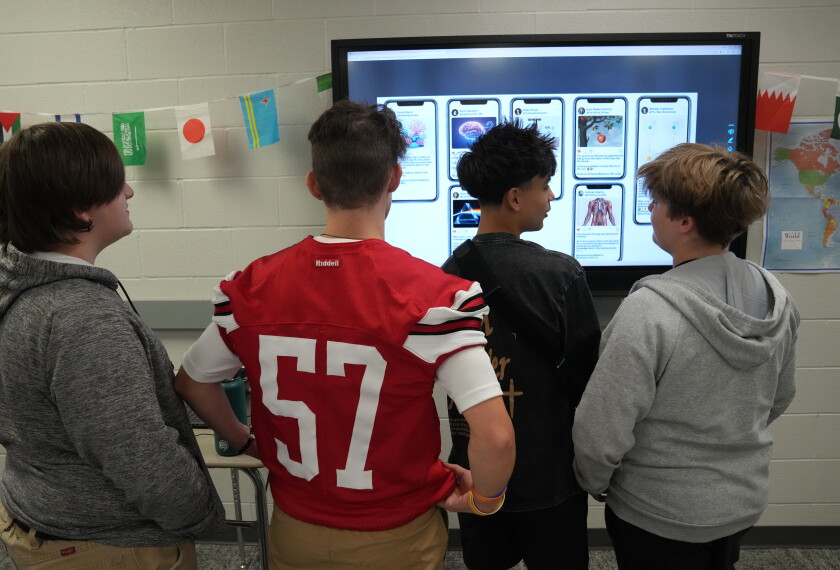
Students present their AI powered-projects designed to help boost agricultural gains in Calla Bartschi’s Introduction to AI class at Riverside High School in Greer, S.C., on Nov. 11, 2025.
  • Save to favorites
  • Print

It’s not just teachers who are worried about AI’s effect on students’ abilities to think critically. Students are concerned, too, according to a new survey of middle, high school, and college students by the RAND Corp.

Nearly 7 in 10 middle and high school students say they are concerned that using AI for schoolwork is eroding their critical thinking skills. And students are growing more worried.

Forty-eight percent of middle school students said they were concerned about AI harming their critical thinking skills in February of 2025. That number climbed to 68% by December. Among high schoolers, that percentage increased from 55% to 65% over the same time period. College students, too, expressed concern, with 70 percent indicating that AI use may be harming their critical thinking skills.

“Just thinking it harms your critical thinking isn’t proof that it’s harming your critical thinking,” said Heather Schwartz, the co-director of the American Youth Panel at RAND. “But there are a handful of studies coming out showing that AI is functioning like a crutch for students.”

Even though students are worried about AI undermining their critical thinking skills, they are increasingly using the technology to do their homework.

AI might be giving you a really beautiful explanation about what you can do and how to go about it. It's still removing that step for you. And I think it's shortchanging your learning in the process.

The RAND surveys found that from May to December of 2025, the percentage of middle school students who reported using the technology for homework rose from 30% to 46%, while the percentage of high schoolers rose from 49% to 60%.

While students in college use AI the most, Schwartz said that trend will likely pick up among K-12 students.

“The older the student, the more kids are using it for more classes, for more purposes,” she said. “My sense is that younger students are going to progressively use this more and more.”

General generative AI chatbots—such as ChatGPT, Claude AI, and Google Gemini—are far and away more popular among middle and high school students than other AI-powered tools with more specific purposes, such as those designed for tutoring, mental health, and college and career advising. Forty-nine percent of middle school students and 61% of high school students report using AI chatbots.

What are students using AI for in their schoolwork?

How, exactly, students are using AI for school-related purposes varies by the grade level. The most common tasks high school students use AI for are brainstorming and getting better explanations on assignments, with 37% of survey respondents saying that’s what they use AI for.

Middle school students are most likely to use AI for looking up facts, with 32% of middle school survey respondents saying they do this.

But does using AI to do schoolwork count as cheating?

See also

Students engage in an AI robotics lesson in Funda Perez’ 4th grade computer applications class at Dr. Martin Luther King, Jr. School No. 6 in Passaic, N.J., on Oct. 14, 2025.
Erica S. Lee for Education Week

The survey found that students’ definition of cheating is fairly narrow. On most tasks, a majority of survey respondents ranging from middle schoolers to college students did not consider AI use to be cheating (the report does not separately break out middle and high school responses on this data). The one exception was using AI to get homework answers, which 45% of respondents said constitutes cheating.

Many students are left to determine on their own whether using AI to help do their schoolwork is OK, the report found. A third of middle and high school students indicated that their school had a rule for using AI in homework. The rest indicated that either there was no rule, they didn’t know if there was a rule, or that it depended upon individual teachers.

High school students were more likely than middle schoolers to report that rules for using AI depend upon the teacher and that their teachers are checking for AI use. Consequently, high school students are more worried about getting accused of using AI to cheat, with 64% saying this was a concern for them.

Use of AI might bypass meaningful struggles to learn

In sum, what does this all mean?

The report examined whether a combination of students’ behaviors and beliefs affect whether they use AI for homework. It found that students who are not worried about AI use affecting their critical thinking skills and attend a school where they are allowed to use AI is correlated with heavier AI use for schoolwork.

Students’ perceptions that AI is undermining their critical thinking skills should give educators pause, said Schwartz.

While research on how AI might harm or boost students’ learning is still emerging, and teachers are finding it extremely helpful in their practice, Schwartz said she is concerned with how and when students are using AI. Specifically, she is worried about students using AI for what she calls first-draft thinking.

“That initial struggle, the blank page, the math problem that doesn’t yet have any steps in it, that you have to figure out what first step to take—that is like a tiny moment of friction,” she said. “It’s a cognitive challenge that you as a student have to draw on your background knowledge. And AI might be giving you a really beautiful explanation about what you can do and how to go about it. It’s still removing that step for you. And I think it’s shortchanging your learning in the process.”

Events

This content is provided by our sponsor. It is not written by and does not necessarily reflect the views of Education Week's editorial staff.
Sponsor
Recruitment & Retention Webinar
Hiring, Retention, and Fill Rates: A Data-Driven Sub Strategy
Explore what keeps substitutes coming back and hear how one district rebuilt its substitute hiring process and improved its fill rate.
Content provided by Frontline Education
Early Childhood K-12 Essentials Forum Early Childhood Education: Building Essential Skills for Success
Join this free virtual event to examine the biggest challenges in supporting young children, from preschool through elementary school. 
This content is provided by our sponsor. It is not written by and does not necessarily reflect the views of Education Week's editorial staff.
Sponsor
Student Absenteeism Webinar
Attendance Isn't an Attendance Problem
Boost attendance by strengthening relationships, belonging, and support with practical strategies from Doug Fisher & Nancy Frey.
Content provided by Corwin

EdWeek Top School Jobs

Teacher Jobs
Search over ten thousand teaching jobs nationwide — elementary, middle, high school and more.
View Jobs
Principal Jobs
Find hundreds of jobs for principals, assistant principals, and other school leadership roles.
View Jobs
Administrator Jobs
Over a thousand district-level jobs: superintendents, directors, more.
View Jobs
Support Staff Jobs
Search thousands of jobs, from paraprofessionals to counselors and more.
View Jobs

Read Next

Artificial Intelligence LAUSD Adopts Moratorium on Student AI Use, Another Move to Limit Classroom Tech
The nation's second-largest district is pausing student use of generative artificial intelligence.
Howard Blume, Los Angeles Times
3 min read
A student uses Ed, a new district-developed Artificial Intelligence-assisted "learning acceleration web-based platform that will boost student success and revolutionize how K-12 education is tailored to meet individual needs," during the official launch event at Edward R. Roybal Learning Center in Los Angeles on March 20, 2024 .
A student uses Ed, the Los Angeles Unified School District's custom AI platform that later failed, during a launch event at Edward R. Roybal Learning Center in Los Angeles on March 20, 2024. LAUSD has now adopted a moratorium on student AI use. New York City schools have banned AI-powered tools for elementary and middle school students, meaning the nation's two largest districts have adopted major restrictions on student AI use.
Christina House/Los Angeles Times/TNS
Artificial Intelligence New York, Los Angeles Restrict Student AI Use. Will Other Districts Follow?
The restrictions come amid rising concerns about overreliance on technology in schools.
7 min read
Mayor Zohran Kwame Mamdani and Schools Chancellor Kamar H. Samuels today announced a moratorium on student-facing generative Artificial Intelligence (AI) use in schools, alongside a new screen time policy, a decision that will impact nearly 600,000 public school students, or two-thirds of the system's total enrollment at The Brooklyn Steam Center in New York City on Sept. 2, 2026.
Mayor Zohran Kwame Mamdani and Schools Chancellor Kamar H. Samuels announced a moratorium on student-facing generative artificial intelligence use in schools and a new screen-time policy during a press conference at The Brooklyn Steam Center in New York City on Sept. 2, 2026. The moratorium is part of a growing nationwide movement to ban or limit the use of AI and decrease screen time in schools.
Katie Godowski/MediaPunch /IPX via AP
Artificial Intelligence Spotlight Spotlight on Using AI with Purpose: Building Responsible Practices for Schools
Learn how to implement AI responsibly with practical guidance for school leaders, teachers, and district decisionmakers.
Artificial Intelligence Schools Caught Flat-Footed After Google Makes Gemini Chatbot Available to All Students
Schools wrestle with the question of whether to permit or prohibit access to the AI chatbot.
5 min read
Social Studies teacher Simon Sharick supervises students at the Plymouth High School in Ohio on how to properly prompt the Gemini Ai App to get their desired information. Students were using the Gemini App for the first time on Friday, Aug. 28, 2026.
Students in a social studies class on Aug. 28, 2026, at Plymouth High School in Plymouth, Ohio, learn how to properly prompt Google's Gemini chatbot to generate useful and accurate information. In August, Google made Gemini available to K-12 students of all ages. <br/>
Ruddy Roye for Education Week