
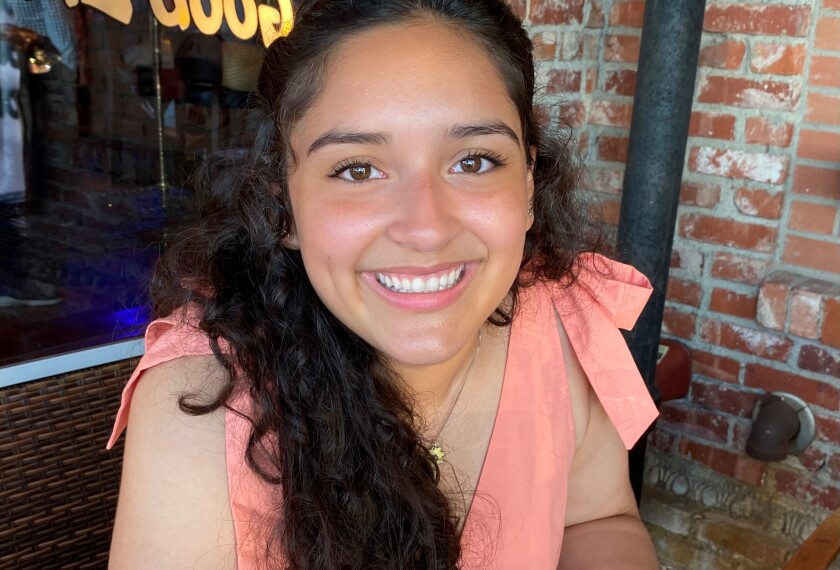
The pandemic has exacerbated anxiety and depression among young people. Some schools are training students to help spot early signs of mental illness in their peers, and connect them with adult support. Sofia Mendoza is one of those trained students. She’s a senior at Hilliard Davidson High School, in Hilliard, Ohio, and works on the school’s “Hope Squad.” This interview has been edited for length and clarity.
The pandemic has affected a lot. Now there’s a learning gap, so school has become a lot more of a stressor for students than it was before, and it causes more anxiety, and people need more help. Some students’ families have lost jobs, so they’ve got a lot more issues. They’re heavier issues that they’re dealing with now.
When I see that my friend is struggling in school when they usually don’t, or they’re super stressed out and it’s not related to tests, it’s more what they’ve been going through, then I’m more concerned. There are preventive actions we can take.
I was already doing this with my peers. I would check in on them, making sure that they’re OK. Then I heard that Hope Squad was coming, and I was elected into it [by my peers]. And it made sense with what I was already doing. Like, if I knew a friend was struggling, I now had a new kind of toolkit I could pull from to have a more-educated conversation with them. That helped a lot.
From our training, we learn the red flags to watch for. Once we know what they need, we’re just guiding them towards it. Some students won’t get help because they’re just afraid to ask for it. But if a peer knows, and if their struggle is seen and heard, then they’re able to say, OK, yes, I do need the help. And we can get them to go to an adult themselves.
If it escalates to a point where you’re afraid for their life, like if a student straight-out says, “I want to commit suicide, I don’t want to be here anymore,” you need to contact an adult, because you don’t know what that student might do next.
I’ve had referrals from other students, too, who were dealing with a situation with another student, and didn’t know what to do. They needed someone else, and they came to a Hope Squad member.
Recently, one of my peers who’s had a series of mental health issues—and gotten help before—they weren’t doing well in school. They’d failed a test and wouldn’t reach out for help. We tutored them and got them help, but unfortunately they had a parent who’s had some health issues, and that was an added stress.
Once we saw all of that, we knew we had to contact our school counselors. We talked to the student, and she realized that she does need help, and she needed it more than ever. She was admitted to a mental health program [outside school] and has now received a lot of help. She’s doing a lot better now.
Trying to ‘spread as much kindness as I can’
Last week, on social media, one of my friends’ stories was like, “Give me reasons to live. I bet you can’t name two.” I was kind of shocked because they were kind of under my radar. I thought they were doing well. So I DM’ed them and I said, “I have a few [reasons to live].” And I gave them a bunch.
And I was like, I want to see what kind of color you dye your hair next time, because they always have dyed hair. And I let them know, like, there’s someone else that, like, I know we’re not that close, but I care about you, you know? And I want to see you every day. And so I told them that.
I thought they were doing better, so I kind of left that situation alone a little bit, but I checked in, and they were to a point where I didn’t have to inform my counselor. But I’m still continuing to check on them. And if anything changes I will.
Hope Squad does more things, too. We also promote positivity throughout our school, like kindness, and letting our students know that they’re heard, and that we want them to be seen, and that we care about them, and we’re there for them no matter what. That’s a major part of why I joined Hope Squad.
I’m that student that kind of over-commits. Going into my freshman year, I didn’t realize that if I give so much, I won’t have enough energy to give. I kind of lost myself a little bit. But part of Hope Squad is self-care. So I learned that it’s OK to be a little selfish sometimes, like rein it in, make sure that you’re doing OK before you help others.
I also have my fellow Hope Squad who will help me any day of the week, so I also have them to lean on. I also go to the advisory team in our building for advice. If I’m feeling stressed or if I have a situation that is beyond what I know to help. And they always check in on us, too.
Being on Hope Squad has taught me to branch out. Freshman year I was maybe kind of introverted, and would stay with my niche, my kind of friends, like the nerds, you know? And now I can say I’ve talked to a bunch of different people, different groups. Now if I see a kid in the hallway and they look like they’re not having such a great day, I’ll compliment them or something, just try to spread kindness as much as I can.


